
← Lana Development | Projects | Contact

Tag: Market thesis

  • Real Estate Tokenization: What Investors Must Know

    Real Estate Tokenization: What Investors Must Know

    Real estate tokenization revolutionizes property investment by converting physical assets into digital tokens on blockchain platforms. This innovation enhances liquidity, transparency, and accessibility in the real estate market. Recent legislative developments in the United States are shaping the regulatory landscape for this emerging sector.

    By Luis Noronha
    Real estate tokenization

    Understanding Real Estate Tokenization

    Tokenization involves representing ownership of real estate assets through digital tokens on a blockchain. Each token signifies a fractional share of the property, allowing investors to buy, sell, or trade these shares with greater ease. This process democratizes real estate investment, enabling participation from individuals who might not have the capital for traditional property investments.

    Recent U.S. Legislative Developments

    Lummis-Gillibrand Act (July 2024)

    In July 2024, the U.S. Congress passed the bipartisan Lummis-Gillibrand Act, establishing a comprehensive framework for digital assets. This legislation designates the Commodity Futures Trading Commission (CFTC) as the primary regulator for most digital assets, excluding those classified as securities, which remain under the Securities and Exchange Commission (SEC). The act clarifies token classification, facilitating compliance for real estate tokenization projects. 

    Tokenization Report Act of 2024

    The Tokenization Report Act of 2024 mandates a detailed study of the implications of asset tokenization across various sectors, including real estate. The findings aim to inform future regulatory approaches and ensure that the benefits of tokenization are realized while mitigating potential risks. 

    Congressional Hearings on Tokenization

    On June 6, 2024, the House Financial Services Committee conducted hearings to explore the tokenization of real-world assets. Discussions highlighted the potential of tokenization to enhance market efficiency and transparency. However, there are concerns regarding regulatory challenges and the need for clear guidelines to protect investors. 

    Real estate tokenization

    Market Growth and Future Outlook

    The real estate tokenization market is experiencing significant growth. Projections indicate an increase from $3.5 billion in 2024 to $19.4 billion by 2033, reflecting a compound annual growth rate of 21%.  Deloitte anticipates that tokenized private real estate funds could reach $1 trillion by 2035, representing 8.5% of the market. 

    Conclusion

    Real estate tokenization is poised to transform the investment landscape by offering greater accessibility and efficiency. Recent U.S. legislation provides a foundational regulatory framework, encouraging innovation while aiming to safeguard investors. As the market evolves, stakeholders must stay informed and adapt to the changing legal and technological environment.

    Sources:

    https://www.congress.gov/bill/118th-congress/house-bill/8464?utm_source=chatgpt.com

    https://www.axios.com/2024/06/06/crypto-blockhain-tokens-real-estate-eggs-stocks?utm_source=chatgpt.com

    https://www.appventurez.com/blog/real-estate-tokenization?utm_source=chatgpt.com
    https://www2.deloitte.com/us/en/insights/industry/financial-services/financial-services-industry-predictions/2025/tokenized-real-estate.html?utm_source=chatgpt.com

  • Rising Construction Costs

    Rising Construction Costs

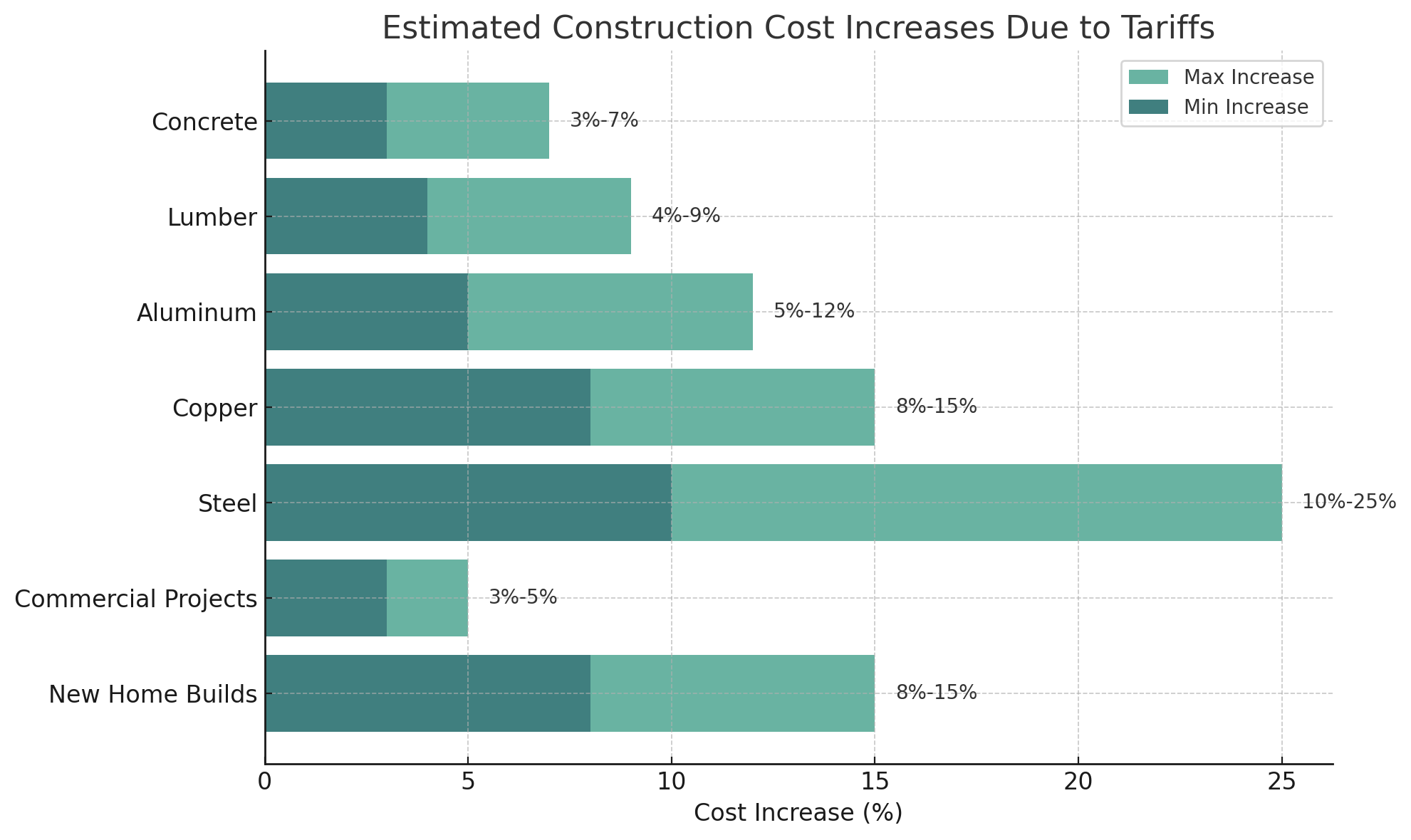
    The latest round of U.S. tariffs is reverberating across the real estate and construction sectors—and for investors, the message is clear: rising construction costs.

    Underwriting assumptions need to evolve.

    Over the past few months, the relentless inflation of material costs has been chipping away at margins and disrupting timelines across almost all asset classes. Whether you’re supporting residential communities, build-to-rent portfolios, or mixed-use developments, the impact is starkly evident in the financials.

    What’s Changing?

    Construction inputs are rising fast, often faster than end prices can keep pace:

    Construction costs Increase

    Early Signs of Market Impact

    Housing starts are down 14.2% as of March—the lowest in eight months

    Consumer behavior is shifting: 30% of Americans are postponing major purchases, and 25% are canceling them entirely

    Developers are pausing deals or revising models mid-cycle

    Implications for Investors

    If you’re capitalizing on projects in this environment, here are the key considerations:

    1. Re-underwrite Immediately

    Hard costs have shifted significantly. Sponsors who haven’t updated budgets since Q4 2024 are likely underestimating exposure.

    2. Focus on Developer Agility

    Partners with boots-on-the-ground capabilities and control over construction (GC or affiliated build teams) are better positioned to manage volatility.

    3. Mitigate Execution Risk

    Ask about procurement timelines, supplier diversification, and contingency strategies. The cheapest deal may not be the most resilient.

    4. Prioritize Location and Product Resilience

    Markets like Florida, mainly coastal or high-demand pockets, can better absorb pricing shifts due to persistent demand. Product types with service-based revenue or long-term hold strategies may also fare better.

    5. Monitor Policy Movements

    Trade policy is highly political. A change in administration or global relations could reverse or deepen the current impact—stay informed.

    Our View

    At Lana Development, we’re adapting quickly, revisiting budgets, accelerating procurement, and doubling down on local supplier networks. Projects with the proper fundamentals and flexibility still present attractive returns. But in this environment, investor discipline is everything.

    I’d be happy to connect if you’re evaluating real estate allocations or need support with stress-

    testing construction-heavy investments.

    Sources:

    https://www.businessinsider.com/general-contractor-tariffs-have-caused-me-lose-business-2025-4?utm_source=chatgpt.com

    https://www.mpamag.com/us/mortgage-industry/market-updates/trumps-tariffs-could-add-thousands-of-dollars-to-new-home-prices/524826?utm_source=chatgpt.com

    https://www.bisnow.com/national/news/construction-development/cbre-tariffs-could-drive-cre-construction-costs-up-5-put-projects-on-hold-128582?utm_source=chatgpt.com

    https://www.businessinsider.com/tariffs-trump-steel-aluminum-tiles-development-real-estate-construction-2025-3?utm_source=chatgpt.com

    https://www.reuters.com/markets/us/us-single-family-housing-starts-tumble-an-eight-month-low-march-2025-04-17/?utm_source=chatgpt.com

    #RealEstateInvesting #ConstructionCosts #Tariffs #CRE #DevelopmentStrategy #InvestorInsights #RiskManagement #newdevelopment #realestateinvestor

  • Mitigating Risks Amidst Fluctuating Real Estate Markets

    Navigating the Waves of Market Volatility

    By Luis Noronha 07/01/2024

    Understanding and adapting to market volatility is crucial in real estate investment to maintain stability and enhance the profitability of your investment portfolio. This article delves into the strategic approaches seasoned investors employ to navigate fluctuating markets effectively, ensuring sustainable success through various economic climates.

    Understanding Market Cycles

    A thorough comprehension of real estate market cycles forms the bedrock of successful investing. These cycles, characterized by periods of expansion, peak, contraction, and trough, mirror broader economic trends and are influenced by factors such as interest rates, employment data, and GDP growth. Each phase presents unique challenges and opportunities.

    For instance, during an expansion, investors might find ample opportunities to acquire properties as prices rise, whereas, in contraction phases, the focus might shift towards maintaining occupancy and cash flow in existing investments. Recognizing which phase the market is in can significantly inform investment decisions, helping investors capitalize on opportunities and mitigate risks associated with each stage.

    Diversification of Investments

    Diversification is a cornerstone strategy for mitigating risk in volatile markets. It involves spreading investments across various property types, such as residential, commercial, and industrial, as well as different geographical locations. This strategy reduces the impact of a downturn in any single market or sector, ensuring more stable returns across an investment portfolio. For example, while residential properties might suffer from high vacancy rates during an economic downturn, industrial properties could remain stable or even experience growth, balancing the investment portfolio.

    Financial Resilience

    Building and maintaining financial resilience is essential for navigating market fluctuations. It involves strategies such as ensuring a solid cash reserve and generating positive cash flow from properties. Financial resilience enables investors to withstand unexpected downturns without liquidating assets at unfavorable times. Effective cash flow management, including meticulous budgeting and economic forecasting, ensures that funds are available to cover operating expenses and potential market downturns, thus protecting investments from possible losses.

    Leveraging Technology for Market Insights

    Utilizing cutting-edge technology and data analytics is increasingly important in real estate investing. Tools that offer real-time data analytics, predictive modeling, and market forecasts can give investors the insights to make informed decisions swiftly as market conditions change. For instance, platforms that analyze rental trends, property price movements, and investor sentiment can provide a crucial advantage in identifying emerging opportunities and potential risks.

    Long-Term Strategic Planning

    Adopting a long-term investment perspective can help investors weather short-term market volatility. Investments planned with a long-term view are typically less affected by transient market fluctuations and can yield more consistent returns. This approach involves careful property selection based on factors that will drive long-term growth, such as location desirability, future community developments, and changes in demographic trends that could influence property values and rental demand over time.

    Effective Risk Management

    Risk management in real estate investing involves more than just recognizing potential risks; it involves actively developing mitigation strategies. It might include diversifying property holdings, utilizing fixed-rate financing to hedge against interest rate volatility, or implementing robust property management practices to ensure high occupancy and tenant satisfaction. Regular risk assessments can help identify new risks and refine existing strategies, ensuring the investment remains secure regardless of market conditions.

    Continuous Education and Adaptation

    The real estate market is dynamic and influenced by myriad factors, including technological advancements, economic shifts, and regulatory changes. Successful investors continuously learn to keep abreast of new developments and strategies. This ongoing education is crucial for adapting investment strategies to current market conditions and emerging trends, maximizing returns, and minimizing risks.

    Engaging with Industry Experts Collaborating with industry experts, including economists, market analysts, and seasoned real estate advisors, can offer significant benefits. These professionals provide specialized insights and recommendations for effectively navigating complex market scenarios. Their expertise can help fine-tune investment strategies, identify undervalued markets or properties, and offer guidance on regulatory compliance and market predictions.

    By integrating these strategies, real estate investors can effectively mitigate the risks associated with market volatility, ensuring their investments are secure and profitable. Navigating market fluctuations successfully requires a blend of proactive strategy development, financial acumen, and a deep understanding of market dynamics, all underpinned by a commitment to ongoing education and professional development.

    This structured approach not only guards against potential pitfalls but also positions investors to capitalize on opportunities in fluctuating markets, paving the way for long-term investment success.

  • Identify High-Return Properties.

    Identify High-Return Properties.

    Unlocking the Potential of Profitable Real Estate Investments

    by Luis Noronha /June 2024

    The real estate investment landscape is rich with opportunities for substantial financial gains, provided investors can adeptly Identify High-Return Properties. Achieving success in this competitive arena requires a strategic approach, combining market insight, financial acumen, and understanding economic trends. This article explores the comprehensive strategies seasoned investors employ to identify and capitalize on high-return real estate opportunities efficiently.

    Deep Market Understanding

    A robust understanding of market dynamics is foundational for any successful real estate investor. It involves analyzing economic indicators that impact property values, such as employment rates, GDP growth, and consumer spending trends. These indicators can provide insights into the overall health of an economy and suggest potential hotspots for investment.
    Additionally, investors must assess the local real estate market, considering property demand, supply constraints, and future development plans. By understanding these elements, investors can pinpoint areas likely to experience growth, making them prime targets for profitable investments.

    Identifying High-Return Properties.

    Strategic Property Analysis

    Selecting the right property goes beyond simple location analysis. Investors must evaluate the property’s potential for appreciation, rental income possibilities, and intrinsic value enhancements, which includes a detailed assessment of the property’s condition, potential for
    upgrades, and alignment with current market demands. For instance, properties in areas with growing employment opportunities or those near significant infrastructure projects often present lucrative investment opportunities due to their potential for rapid appreciation and strong rental demand.

    Financial Metrics and Valuation Techniques

    Proficiency in financial metrics is critical for identifying high-return properties. Essential calculations include the return on investment (ROI), cash flow analysis, and the capitalization rate (cap rate).
    These metrics help investors assess a property’s financial performance and compare it with other potential investments. Additionally, understanding different property valuation techniques, such as comparative market analysis (CMA) and the income approach, allows investors to price accurately and value properties, ensuring sound and potentially lucrative investments.

    Leveraging Technology and Data

    In today’s digital age, technology is pivotal in real estate investment. Advanced data analytics, artificial intelligence, and real estate investment software can streamline the process of identifying high-return properties. These tools provide comprehensive data that can predict
    market trends, analyze property prices, and suggest the best times to buy or sell. For example, platforms that offer real-time analytics on rental yields and historical price trends can help investors make informed decisions quickly and efficiently.

    Building Networks and Relationships

    Networking is a powerful tool in a real estate investor’s arsenal. Building relationships with real estate agents, brokers, property managers, and other investors can provide access to a wealth of knowledge and insider information. Often, the best deals are not listed on public markets; hence, a robust network can provide investors exclusive access to off-market deals and first-mover advantages in competitive areas.

    Profit from Investments

    Effective Negotiation Skills

    Mastering the art of negotiation is essential for securing real estate investments at favorable prices. Effective negotiation involves understanding the seller’s motivations, the property’s market value, and the current market conditions. By negotiating better purchase terms,
    investors can significantly enhance the potential returns from a property.

    Risk Assessment and Management

    Identifying high-return properties also involves managing potential risks. Investors must conduct thorough due diligence to uncover any property’s legal, financial, or structural issues. It includes reviewing zoning laws and property title details and conducting physical inspections.
    Effective risk management ensures that investments are secure and potential issues are addressed before impacting profitability.

    Continuous Learning and Adaptation

    The real estate market is dynamic and ever-changing. Successful investors commit to continuous learning and adaptation to keep pace with new developments, regulatory changes, and technological advancements. Staying informed through real estate seminars, workshops, and industry reports is crucial for maintaining an edge in the market.
    By employing these strategies, real estate investors can enhance their ability to identify high-return properties efficiently. It will maximize financial returns and minimize exposure to unnecessary risks. These practices provide a foundation for a successful and
    sustainable real estate investment career, enabling investors to capitalize on opportunities and navigate challenges in the ever-evolving real estate market.

    References:
    The Power of Connections: Networking to Find Cash Buyers. https://housebuyerstexas.net/thepower-of-connections-networking-to-find-cash-buyers

    EagleIdaho.com. https://eagleidaho.com/AgentDetails.aspx?AgentID=11

    Real Estate Agent in Raleigh, NC, Shares Strategies for Navigating Market Trends and Uncertainties | ABNewswire. https://www.abnewswire.com/pressreleases/real-estate-agent-in-raleigh-nc-shares-strategies-for-navigating-market-trends-and-uncertainties_685730.html

    Stock market analysis Word template for print document. https://imaginelayout.com/word-template-2847/

  • How Developer Margin Compression Actually Works — And Why In-House Construction Is the Only Real Defense

    How Developer Margin Compression Actually Works — And Why In-House Construction Is the Only Real Defense

    Every real estate developer is dealing with developer margin compression right now. Interest rates that reprice quarterly. Construction materials 35–40% more expensive than they were in 2020. Labor shortages that turn a five-week framing job into an eight-week framing job. Insurance premiums that keep drifting up. And all of that sits on top of land basis that hasn’t come down.

    If you’re an investor evaluating real estate opportunities in 2026, this is the environment your sponsor is operating in. The question is: who’s better positioned to survive it — and to protect your returns while doing so?

    What developer margin compression actually looks like

    According to the McKinsey Global Institute’s Reinventing Construction research, the average large construction project runs 16% over budget and 20% over schedule. For a developer with tight underwriting, those percentages come directly out of investor equity. For a developer with loose underwriting, they come out of investor and sponsor equity — but only after the sponsor has already collected fees.

    Now stack the environmental pressures on top of that industry baseline. According to CoreLogic’s Construction Cost Index and BLS JOLTS data, non-residential construction inputs are up 35–40% since 2020. There are more than 650,000 unfilled construction jobs in the U.S. Permitting timelines in Florida’s premium coastal submarkets — where we build — run 8 to 18 months. Every one of those factors expands the gap between a proforma’s Day-One assumptions and reality.

    The industry answer to developer margin compression is usually one of three responses:

    1. Cut quality to preserve margin. Bad long-term for buyer demand, resale, and reputation.
    2. Raise prices to preserve margin. Works only until it prices out the target buyer.
    3. Cut yourself a wider fee to preserve your margin while the project’s return profile deteriorates. Not investor-aligned.

    None of these actually solve the problem for the LP.

    The real answer to developer margin compression: eliminate the GC layer

    Most real estate developers are not builders. They find land, raise capital, hire architects, secure permits, and then hand construction to a third-party general contractor. The GC hires subcontractors, manages the site, and delivers the finished product. That structure works fine in a low-inflation environment. In a compression environment, it becomes very expensive.

    Here’s the math a lot of investors don’t see:

    • GC markup: typically 15–20% on top of actual construction cost. On a $12M build, that’s $1.8M–$2.4M.
    • Change orders: average 8–10% of budget on a project of this size. On a $12M build, that’s another $960K–$1.2M.
    • Schedule overrun: the McKinsey 20% average, applied to carrying costs, adds another $200K–$400K depending on financing structure.

    Total unnecessary drag on a $12M build routed through a third-party GC: roughly $3M–$4M.

    That $3M+ is not “developer profit” or “investor return” or “sponsor promote” — it’s simply value the project never realizes because two entities with different incentives were operating on the same project.

    Why Lana operates as its own GC

    Lana Development is a licensed general contractor. We build every project we develop. Our construction team has managed projects valued up to $160 million. There is no third-party markup layer. There is no misalignment between the developer and the builder — because they’re the same team. Cost overruns are managed in real time by the same people underwriting the project’s returns. Change orders are rare and small because the design team and the build team never disagree with each other about scope.

    This is not a theoretical claim. Turquoise Homes on 30A — 66 luxury single-family lots delivered on 30 acres — was executed through the peak of the 2020–2023 cost-inflation window. In-house construction kept cost discipline. The project delivered $30 million in net profit on $7 million of equity in 3 years: a 5.29x equity multiple and 74.2% annualized IRR on invested capital. That result is not luck. It’s what happens when the developer and the builder are the same entity in the exact moment of the cycle when developer margin compression is most acute.

    Five questions every investor should ask about developer margin compression

    Regardless of whether you invest with Lana, if you’re evaluating a real estate opportunity in 2026, insist on answers to these five questions before you commit capital:

    1. Who is your general contractor — and how is their fee structured?
    2. What’s your final-cost-vs-original-proforma track record on the last five projects?
    3. How do you handle cost overruns — and who absorbs them?
    4. What construction reporting will I receive during the build?
    5. Are you co-investing your own capital in this project?

    A sponsor who can answer those five with real specificity has already earned a significant amount of your trust. A sponsor who can’t should not be trusted with your capital in a margin-compression environment.

    The bottom line on developer margin compression

    Developer margin compression is real, and it’s not going away. Developers who outsource construction will feel it, absorb it, and pass it through to their investors. Developers who build in-house will absorb it too — but they’ll absorb far less of it, and their investors will feel almost none of it.

    That structural difference is the single biggest thing to underwrite when you evaluate a real estate sponsor right now.

    Interested in how this plays out in a specific deal? Schedule a 15-minute call with Luis Noronha or review the Coastal Living Collection.

  • Understanding the implications of stubborn inflation on your real estate investments is crucial for making informed decisions

    Stubborn inflation can positively and negatively affect various real estate sectors, presenting a complex picture for investors.

    In the warehouse segment, rising construction costs due to inflation can amplify the expenses of developing new industrial spaces. This may lead to higher leasing rates, potentially affecting tenant demand and impacting the overall profitability of warehouse investments. However, warehouses can benefit from increased rents as businesses seek storage solutions in response to rising costs, potentially offsetting inflationary pressures.

    In the multifamily sector, stubborn inflation can increase operational costs, including maintenance, insurance, utilities, and property management expenses. Landlords may find it challenging to pass these increased costs to tenants, especially in rent-controlled areas, affecting the cash flow of multifamily properties. Additionally, higher inflation can lead to increased borrowing costs for developers, potentially slowing down new construction projects and limiting the expansion of the multifamily housing market.

    Triple net (NNN) deals, where tenants cover expenses like property taxes, insurance, and maintenance, may face challenges in a high-inflation environment. While these leases protect rising operating costs, landlords may still encounter difficulties adjusting lease terms to keep pace with inflation. Investors in NNN properties may need to carefully assess lease agreements and tenant creditworthiness to mitigate risks associated with inflation eroding rental income. Conversely, NNN properties can offer stability and consistent income streams, making them an attractive option for investors seeking to hedge against inflation in their real estate portfolios.

    Stubborn inflation poses formidable challenges to new construction of single-family homes, elevating material costs, labor expenses, and financing rates. As construction expenses escalate, developers encounter obstacles in maintaining affordability for buyers while striving for profitability. Higher home prices may dampen demand, impacting the market’s equilibrium. Rising interest rates can further strain developers’ access to funding, potentially slowing down construction activities and limiting the supply of new homes. Navigating these inflationary headwinds demands strategic cost management, innovative solutions, and adaptive approaches to sustain growth and viability in the single-family home construction sector.

    A real estate investor should associate with seasoned professionals who have better navigated inflationary times to face these challenging scenarios.

  • Demography and real estate markets shift

    Demographic shifts change #markets. Particularly on #realestate. The new trends are in favor of #singlefamilyhome portfolios instead of #multifamilyhousing properties. The reason is the exit strategy. While you can easily dispose of a #SFH, disposing of a multifamily property on a high vacancy market in a profitable way, requires the stress of doing a #condominium conversion and selling individual units.

    For more detailed info look at the entire original post at: Demographics: Renting vs. Owning by Calculate Risk.

  • Three things to know before investing in Real Estate

    1. Understand the real estate cycle before investing

      The first thing we need to know to start to analyze any real estate opportunity is to understand where we are on the real estate cycle. And this is extremely local. What happens in a specific neighborhood might be completely different from 5 miles away. Are we on an uptrend or downturn? How long has the market been on that stage? What are price trends signaling? Is the market changing or close to a change?Although there are good real estate investments in every cycle, different markets require different approach and investment strategies.

    2. Follow demographic trends

      Nothing is more powerful then demographic trends. They can override economic cycles creating a different reality in a specific city or state. Fundamentally, we need to be aware of the social-economic changes. Watch out for migration and age shift trends as they require specific products and services.

    3. Always buy cheap

      It is very difficult to make returns out of an overvalued property. Do a thorough real estate comparables analysis before any purchase.