Why the only Florida operators left standing are the very largest publics, the very disciplined privates, and almost no one in between — and what that gap means for capital.
FL Real Estate Insider — Week of May 25, 2026 By Luis Noronha
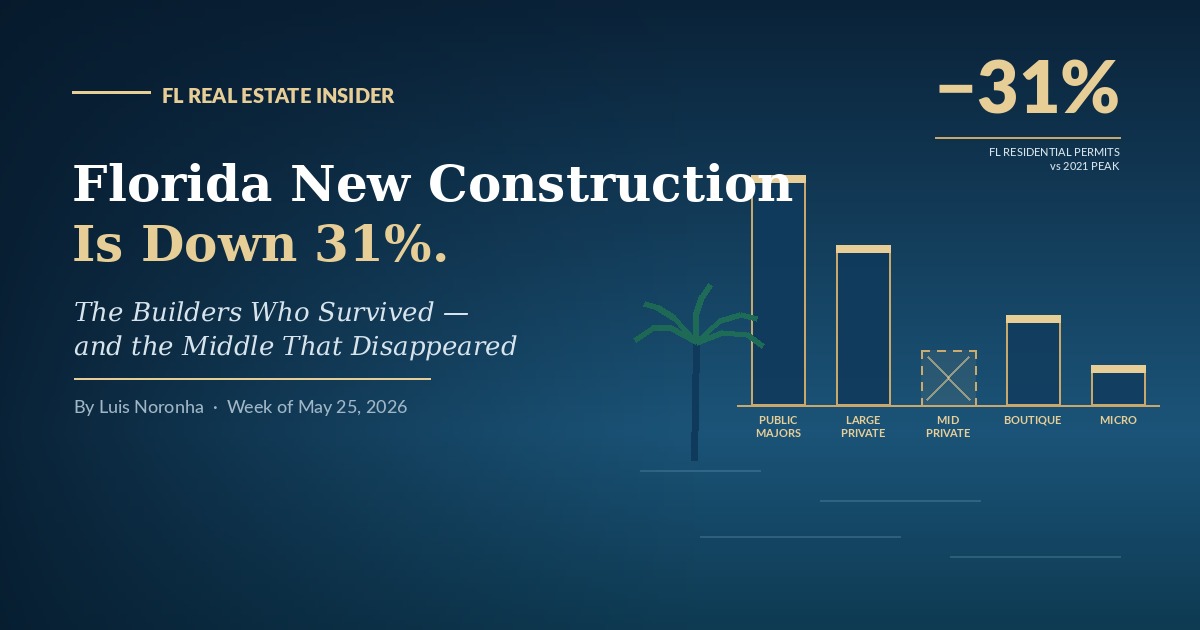
A number that should be on the front page of every Florida real estate publication this spring, and instead is in almost none of them: Florida residential building permits are down roughly 31% from the 2021 peak. (Shovels — Florida Housing Market Outlook: What Building Permit Data Says)
That is not a normal-cycle slowdown. That is a structural reset of the supply side of the Florida new construction market, and the part of the story that nobody is telling cleanly is who is still building and who is not.
This week I want to lay out what the permit data actually shows, what the public homebuilders’ first-quarter 2026 earnings actually say about Florida, what is happening to the private builder cohort that used to fill the middle of this market, and — clearly marked as opinion — what I think it means for capital allocated to ground-up Florida new construction over the next 24 months.
What the Florida new construction volume numbers actually say
Shovels’ Florida permit dataset shows roughly 66,460 new residential construction permits reviewed in 2025, down from 96,951 in 2023 — a 31% reduction in volume. The cycle low was 2024, when the year-over-year drop hit 21%; 2025 ticked up 1.4%, which is meaningful as a floor signal but is a long way from a recovery. (Shovels — Florida Housing Market Outlook)
The U.S. Census Bureau’s monthly Building Permits Survey for Florida confirms the directional read in the official federal data and is the place to verify any single-month or single-county number. (U.S. Census Bureau — Building Permits Survey, State Monthly, FRED — New Private Housing Units Authorized by Building Permits for Florida (FLBPPRIV))
The headline read most coverage settles on is “Florida is overbuilt and needs to absorb.” That is half right. The state did overbuild specific submarkets in 2021–2022 — Southwest Florida especially — and the inventory in those metros is still working off. But the permit number is a forward indicator of supply, not a backward indicator of absorption, and what it is telling you is that the operators who can pull permits at scale in Florida today are a much smaller and much more concentrated group than they were four years ago.
Who is still building: the publics are eating the market
Inside Florida, the share concentration at the top is severe. Lennar led Florida permits in early 2026 at roughly 1,111 permits, D.R. Horton at 690, PulteGroup at 379. (HBWeekly — Florida’s Top Home Builders, December 2025 Market Snapshot, HBWeekly — Florida Top Home Builders, January 2026) Nationally, D.R. Horton closed more than 87,000 homes in 2025 — the No. 1 spot it took from Lennar two years earlier. (Builder Magazine — The 5 Home Builders Leading the Nation in Closings)
That concentration is being held up by an incentive package smaller competitors cannot match. Lennar reported Q1 2026 sales incentives at roughly 14% of sales price, against a historical average of 4% to 6%, and new orders nonetheless grew 1% year-over-year to 18,515 homes. (Lennar — Form 10-Q for the quarter ended February 28, 2026, FinancialContent — Lennar Q1 Earnings Signal Shift in Housing Market) D.R. Horton’s Q1 2026 homebuilding revenue fell 9% to $6.5 billion and pre-tax homebuilding income fell 30% — yet new sales orders were up year-over-year. (D.R. Horton — Q1 FY2026 Earnings Release)
The mechanism is the captive mortgage subsidiary. DHI Mortgage, Lennar Mortgage, and Pulte Mortgage can deliver below-market rate buydowns — typically 100 to 200 basis points, plus closing-cost credits — on the parent’s own inventory, financed off the parent’s balance sheet. (The Globe and Mail — Homebuilder Earnings: D.R. Horton Sticks Out as Pulte & NVR Sales Tank) A small or mid-sized private builder cannot match that package without taking the project to a loss.
The land-banking layer that institutionalized the gap
The second structural advantage is one almost no consumer-facing Florida real estate coverage has connected to homebuyer outcomes: the land-banking spin-off model.
On February 7, 2025, Lennar completed the taxable spin-off of Millrose Properties, advancing what it has called since 2013 a strategy of becoming a “pure-play land-light manufacturer of homes.” Millrose buys and develops residential land, then sells finished homesites back to Lennar under option contracts with predetermined costs and takedown schedules. It is externally managed by Kennedy Lewis Land and Residential Advisors, an affiliate of Kennedy Lewis Investment Management — an institutional firm with more than $25 billion in assets under management. (Lennar — Lennar Completes Spin-off of Millrose Properties (Feb 7, 2025), SEC — Millrose Properties Form 424B1, FY2025)
A mid-sized Florida private builder bidding against a Millrose-funded lot takedown is, in effect, bidding against Kennedy Lewis. Industry coverage of the broader sector notes that “you can’t attend an industry conference without encountering multiple new land bank funds.” (HousingWire — Understanding Homebuilding’s New Capital Partner: Land Banking, John Burns Research and Consulting — Land Banking Grows as Housing Industry Strategy)
The private-builder cohort being squeezed
The other end of the same trend is now showing up in the bankruptcy docket. The Florida 2025 builder-failure list is not a list of small operators that got over their skis — it is a list of well-known builders with long track records:
- Pegasus Builders, a 45-year-old South Florida luxury builder, declared Chapter 11 in mid-2025 with debts estimated at roughly $10 million. (Medium — Luxury Home Builders Collapse Across Florida Amid Market Shifts)
- Van Der Valk Construction, based in Citrus County, filed Chapter 11 on April 30, 2025, with at least 58 homeowners affected across developments including Inverness Village. (TheStreet — Luxury homebuilder files for Chapter 11 bankruptcy)
- Sion Homes, a Miami-based luxury builder with more than two decades of upscale mansion experience and more than 100 high-end homes delivered, filed Chapter 7 in September 2025 with liabilities exceeding $1 million against less than $1,000 in cash. (Medium — Luxury Home Builders Collapse Across Florida Amid Market Shifts)
- Phil Kean Designs Inc., an Orlando-area design-build firm, filed Chapter 11 under Subchapter V in late November 2025. (TheStreet — Luxury homebuilder files for Chapter 11 bankruptcy)
- Coastal Luxe Homes and Gulfstream Signature Builders, smaller boutique firms, ceased operations in late 2024. (Medium — Luxury Home Builders Collapse Across Florida Amid Market Shifts)
The common factors in the post-mortems are not surprising — insurance during construction roughly doubled across the 2022–2024 cycle, materials cost volatility caught builders working off fixed-price contracts, and labor markets stayed tight — but the structural explanation is the cost-of-capital gap. When the largest publics can self-fund a rate buydown, schedule a finished lot off an institutional land bank, and underwrite a project on volume economics, the private builder running the same project off a regional bank construction loan and a self-financed lot is competing on a different P&L.
Industry M&A is the next step in the same pattern. New Home Co. completed its acquisition of Landsea Homes Corporation in early 2026, creating a privately-held top-25 national homebuilder — a transaction explicitly framed by both parties as a defensive response to scale-driven cost-of-capital pressure. (Rise Well Homes — New Home Co. Completes Acquisition of Landsea Homes Corporation)
The lane the publics structurally don’t serve
Here is the part of the story that matters for the audience this newsletter is actually written for.
The volume-merchant new-construction model the publics run in Florida — D.R. Horton’s median price tier, Lennar’s median tier, Pulte’s median tier, plus the rate-buydown package — is overwhelmingly aimed at the first-time and first move-up financed buyer below the conforming loan limit. It is built around mortgage origination. It is not built around the buyer profile that is currently driving the Florida price tiers that are not softening.
That buyer profile is cash. I am going to stay on one county and one tier for all of it, because mixing geographies and price tiers is exactly how this gets overstated — and Miami-Dade is the only Florida county publishing a verifiable cash share at the top of the market:
- 82% of Miami-Dade $1 million-and-up condo sales closed all-cash in 2025, against a national all-price share of roughly 25%. Four in five transactions in that tier never touch a lender. (MIAMI REALTORS®)
- Below the luxury tier the county still runs far above the national norm: cash was 38.1% of all Miami-Dade closed sales in June 2026 — 48.5% of existing condo sales and 27.6% of single-family. (MIAMI REALTORS®) Miami-Dade posted a 40% cash share in December 2025 against a 27% national average. (MILLION)
- And the tier is growing, not shrinking: in the second quarter of 2026, $1 million-plus sales across Miami-Dade, Broward, Palm Beach, the Treasure Coast and Southwest Florida rose 20.1% to 8,013 single-family homes and 23.5% to 2,590 condos. (Keyes/Illustrated Luxury Market Report, Q2 2026, via RISMedia)
Two honest limits on that. It is one county — no comparable cash share is published for Palm Beach or Southwest Florida, and on volume those markets are larger at the top than Miami-Dade is. And the 82% is a condo figure; no matching number exists for million-dollar single-family. I would rather give you a narrow number that holds than a statewide one that does not.
The customer in those numbers does not need a 200-basis-point rate buydown. The captive-mortgage advantage that the publics use to dominate the first-time-buyer market is irrelevant to a cash buyer at the top of the market. And the volume-merchant production model the publics run is structurally bad at producing the customized, code-current, primary-residence product that cash cohort actually wants — partly because it does not match their distribution, partly because the margin math on a custom-spec project does not fit a public homebuilder’s quarterly earnings cycle, and partly because the publics have spent the last decade explicitly de-emphasizing the land-heavy custom-spec model in favor of asset-light merchant-build.
That is the lane.
What I think — clearly marked as opinion
I want to clearly mark what follows as my view, not data.
Read together, the 31% permit decline, the public-builder incentive escalation, the land-banking buildout, and the private-builder failure list are not four separate stories. They are one story: the Florida new-construction supply side is being squeezed into two viable lanes and hollowed out everywhere in between.
Lane one is the merchant-build volume tier the publics dominate, and they will keep dominating it. Trying to compete with D.R. Horton in 2026–2027 on a 25-home subdivision priced at a first-time-buyer mortgage is, for almost any private builder, a strategic mistake.
Lane two — the one that matters to a serious capital allocator — is custom-spec, code-current, primary-residence product priced for the cash and HNWI move-up buyer. That lane has three durable advantages right now that I do not believe are temporary:
First, the end buyer pays cash, so the rate-buydown dynamic that decides the financed tiers does not apply. Lane two competes on product, location, and execution.
Second, the supply side in lane two has measurably thinned as the small and mid-sized private builders who used to fill it either failed, sold to a larger platform, or moved into project-management work for a public. Less competition for the same end-buyer demand is the most direct definition of pricing power I can give you.
Third, the structural tailwinds I have flagged in recent issues — the insurance wedge in favor of code-current construction, the GSE underwriting wedge in favor of code-current condos, the property-tax reform conversation that disproportionately rewards homesteaded primary residences — all flow through this exact lane. (Background: The Florida Property Tax Fight, Without the Talking Points, The Condo Cliff, Wall Street Landlords.)
The counterpoint to my own thesis: this is not a permanent moat. The publics are smart, the institutional land-bank vehicles will eventually reach further up the price tier, and the cash-buyer pool can soften if global liquidity conditions change. The reading I am giving you is a 24-to-36-month view, not a 10-year view. But on that horizon, the structural setup is as favorable as I have seen it in this cycle.
From the Developer’s Seat
This section is my view, not data.
The single sentence I would offer a sophisticated capital allocator looking at Florida new construction right now: the operators left standing in the lane I would want to deploy into are a much smaller, much more identifiable group than they were three years ago — and the structural advantages of being in that group are widening, not narrowing.
Patient, code-current, custom-spec primary-residence development priced for the HNWI move-up and cash buyer is the lane Lana is built for. It is also the lane in which family-office and HNWI capital — patient, willing to underwrite a 24-month ground-up cycle, earning co-invest economics no institutional REIT can match — has its largest structural edge.
If you are an accredited investor and want to see how this thesis is expressed in named, live Lana projects with full underwriting transparency, that is what the Lana Investor Memo exists for. Reply to this email and I will add you to the next memo distribution.
Sources
- Shovels — Florida Housing Market Outlook: What Building Permit Data Says
- U.S. Census Bureau — Building Permits Survey, State Monthly
- FRED — New Private Housing Units Authorized by Building Permits for Florida (FLBPPRIV)
- Builder Magazine — The 5 Home Builders Leading the Nation in Closings
- HBWeekly — Florida’s Top Home Builders, December 2025 Market Snapshot
- HBWeekly — Florida Top Home Builders, January 2026
- Lennar Corp — Form 10-Q for the quarter ended February 28, 2026 (SEC)
- FinancialContent — Lennar Q1 Earnings Signal Shift in Housing Market
- D.R. Horton — Q1 FY2026 Earnings Release
- The Globe and Mail — Homebuilder Earnings: D.R. Horton Sticks Out as Pulte & NVR Sales Tank
- Lennar — Lennar Completes Spin-off of Millrose Properties (Feb 7, 2025)
- SEC — Millrose Properties Form 424B1, FY2025
- HousingWire — Understanding Homebuilding’s New Capital Partner: Land Banking
- John Burns Research and Consulting — Land Banking Grows as Housing Industry Strategy
- Rise Well Homes — New Home Co. Completes Acquisition of Landsea Homes Corporation
- TheStreet — Luxury homebuilder files for Chapter 11 bankruptcy
- Medium — Luxury Home Builders Collapse Across Florida Amid Market Shifts
- MILLION Luxury — The Golden Triangle of Florida Luxury: Miami, Palm Beach, and Naples Compared
- MIAMI REALTORS® — Miami-Dade Real Estate Posts Best June in Three Years (July 2026)
- Keyes/Illustrated Luxury Market Report, Q2 2026 — Regional Report: High-End Sales Surge Across South Florida, via RISMedia (July 22, 2026)
- Prior published in this newsletter: The Florida Property Tax Fight, Without the Talking Points (May 19, 2026), The Condo Cliff (May 11, 2026), Wall Street Landlords