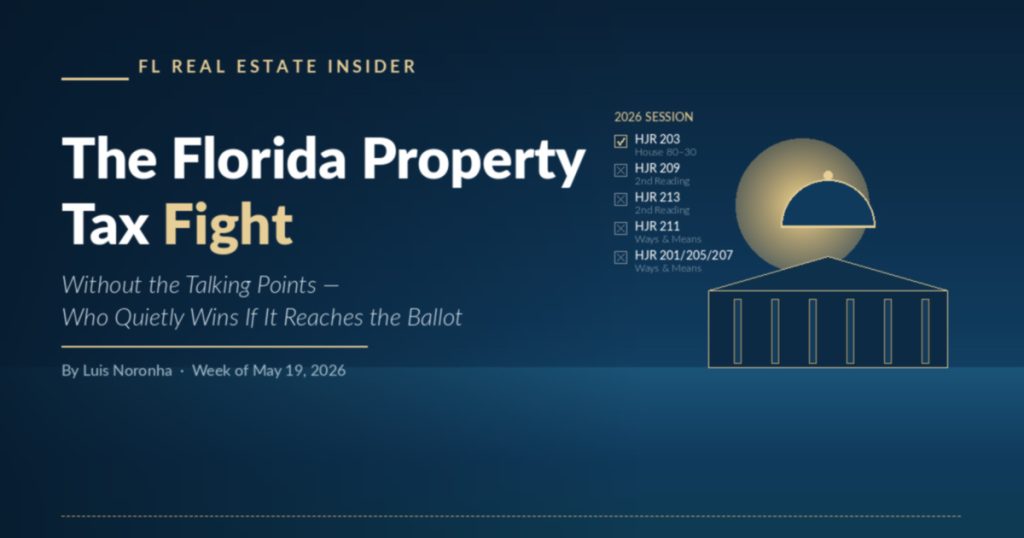
What is actually on the table in 2026, what is not, and who would quietly win if any of it reaches the ballot
FL Real Estate Insider — Week of May 18, 2026 By Luis Noronha
For the last six months, every Florida real estate conversation I have been in eventually turns to the same question: “is the property tax thing actually happening?” The honest answer is that the political pressure is real, the proposals are real, and the mechanics of who would benefit are very real — but almost none of the public commentary you have read about it is accurate enough to use.
So this week I want to do something different. I want to lay the actual proposals out side by side, with the bill numbers, what each one would do mechanically, where each one died in this past session, and what each would mean for a Florida property owner depending on whether you live in your house, rent it, or hold it as an investment.
Then I will mark — clearly — what I think, separate from the statute.
What is actually on the table
Florida’s 2026 regular session produced a cluster of House Joint Resolutions aimed at homestead property taxes. They are not interchangeable. Each does something different, each cleared a different point in the process, and each carries a different bet about who benefits.
HJR 203 — phased elimination of non-school property tax on homesteads. Increases the homestead exemption from non-school ad valorem taxes by $100,000 per year for ten years beginning in 2027, until homesteaded primary residences are fully exempt from non-school property tax by 2037. School property taxes are preserved. HJR 203 passed the House 80–30 on February 19, 2026 — the only proposal to receive a floor vote — and then died in the Senate Appropriations Committee when the regular session ended March 13, 2026 without a hearing. (HJR 203 bill page, Florida House, Florida Phoenix coverage, Florida Policy Institute bill summary)
HJR 209 — a new $200,000 second homestead exemption conditioned on carrying comprehensive property insurance. Stacks on top of the existing homestead exemption, applies only to non-school ad valorem taxes, and applies only to homesteads carrying a comprehensive multiperil policy. The Revenue Estimating Conference put the local-government revenue cost at roughly $8.6 billion per year, and the legislative analysis estimated that about 83 percent of Florida homesteaded homeowners would qualify. HJR 209 cleared all of its committees but died on the Second Reading Calendar without a floor vote. (HJR 209 bill page, Florida House, Florida Policy Institute bill summary)
HJR 213 — reassess homestead property every three years instead of every year, with the cumulative cap held at 3 percent or CPI. Materially slows assessed-value creep for long-tenured homesteaders. Cleared committees, died on the Second Reading Calendar. (Florida Policy Institute bill summary)
HJR 211 — remove the $500,000 cap on Save Our Homes portability. Allows a homesteader to transfer the full accumulated SOH benefit to a new primary residence, not just the first $500,000. Stalled before Ways and Means. (Pegasus Lends portability summary, Florida Policy Institute bill summary)
HJR 201, 205, 207 — additional homestead-exemption increases of varying sizes and structures. All stalled before Ways and Means. (Florida Policy Institute bill summary)
Net of all of that: the 2026 regular session produced exactly one proposal that made it to a full chamber vote, and the April 2026 special session — which also covered the budget — adjourned without putting any property tax measure on the November 2026 ballot. (WFLX coverage of session end, Barnes Walker post-session update)
What everyone is now waiting on
The path forward, if there is one, runs through a third special session this summer. Governor DeSantis has signaled July or August 2026 as the likely window, contingent on a deal with the Senate. To get a constitutional amendment on the November 2026 ballot, both chambers need to approve it with a 60 percent supermajority, and the Secretary of State has a late-August certification deadline. Voters would then need to approve the amendment with a 60 percent supermajority to ratify it. (Fox Business — DeSantis phased approach, WFLX — third special session)
The Senate is the real story. Senate President Ben Albritton has been explicit that the Senate is not ready to send a property tax amendment to the ballot without first solving for the impact on what he has called Florida’s “fiscally constrained” counties. Senate Appropriations Chair Ed Hooper put it more plainly: “There’s 67 totally different counties in this state, and a property tax issue that is great for one county could crush 31 poor counties.” (Florida Voice — Albritton final message, Florida Realtors — Lawmakers continue work on property tax plan)
That is the negotiating wall. The House wants to give voters an option in November. The Senate wants to first answer the question “and how do small counties pay for sheriffs and roads?” before it agrees to anything.
The replacement-revenue math, which is the part nobody on the political side wants to be specific about
The piece of this that the talking points consistently soft-pedal is what replaces the revenue. Florida’s homestead non-school property tax base is large enough that the only credible single-lever replacement is a substantially higher sales tax. The Florida Policy Institute’s analysis concluded that fully replacing the lost revenue with sales tax would require Florida to roughly double its state sales tax to about 12 percent — which would be the highest state sales tax rate in the country. (Kiplinger summary of FPI analysis)
Florida TaxWatch has not endorsed elimination either. Brandi Gunder, Florida TaxWatch’s vice president for research, said publicly that “tax levies are growing at an unsustainable pace” but also that any restructure “has to be a partnership between local, state — everybody on board to know how critical government services will be funded.” (WUSF — TaxWatch on property tax elimination)
Translation: even the conservative-leaning fiscal watchdog is not going to wave this through without a credible replacement plan.
What the live bills would actually do, for the actual people who own actual property
This is where most of the public commentary breaks down. Let me put the mechanics in plain English.
If you own and live in your home (homesteaded primary residence): every live proposal benefits you, on different timelines. HJR 209 would deliver the biggest immediate cut on day one — a $200,000 additional exemption stacked on the existing $50,722 baseline exemption (propertyexemption.com — Save Our Homes 2026 guide), conditional on carrying comprehensive insurance, for a total exemption around $250,722 on non-school taxes. HJR 203 would deliver a deeper cut but over a decade. HJR 213 would slow your assessed value growth. HJR 211 would let you carry your full SOH benefit to your next primary residence with no $500,000 cap.
If you own a second home, an investment property, an Airbnb, or commercial property: none of the live proposals reduce your property tax. The phased elimination in HJR 203 specifically excludes non-homestead property; HJR 209 explicitly excludes non-homestead property; the SOH-related proposals are structurally tied to homestead status. The existing 10 percent non-homestead assessment cap (Florida Statute 193.1556) continues to apply, with the standard reset to full market value upon ownership change. (Pinellas County PA — Non-Homestead 10% Cap)
If you rent in Florida: none of these proposals delivers you direct relief, and the replacement math is structurally regressive — sales tax falls more heavily on lower-income households as a share of income than property tax does. (Kiplinger summary of FPI analysis)
If you are about to close on a new construction primary residence: this is the corner of the market that gets the least public attention and where the mechanics are most interesting. Under existing law, new construction is reassessed at full market value as of the first January 1 after substantial completion, and is added to the capped assessed value of the land. Once homestead is filed, the 3 percent (or CPI) Save Our Homes cap kicks in for the following year. (Florida Department of Revenue — Property Tax Information for First-Time Florida Homebuyers (PDF), § 193.155, Florida Statutes) Layering HJR 209 or HJR 203 on top of that mechanic would compress non-school property tax on a new code-current primary residence faster than on essentially any other asset class in the state.
What I think — clearly marked as opinion
I want to clearly mark what follows as my view, not statute.
The political framing of this debate has been “homeowners versus government,” and that framing is making people miss the more important story. Every live proposal that came out of the 2026 session — HJR 203, HJR 209, HJR 213, HJR 211, all of them — concentrates the benefit on owner-occupied primary residences. By design. Some of them go further and condition the benefit on the property carrying insurance that an actual carrier is willing to write, which in Florida in 2026 means a structure built to current code is materially advantaged over older, harder-to-insure stock.
If any version of this package reaches the November 2026 ballot and passes, three things follow.
First, the relative carrying cost of a homesteaded primary residence drops, and drops most for higher-assessed-value homes — which is the segment with the largest absolute non-school millage bill. That is a transfer toward the move-up and luxury primary-residence buyer, which is the segment new code-current construction is built for.
Second, the relative carrying cost of investor-held inventory — second homes, short-term rentals, institutional single-family-rental portfolios — does not drop. The owner-occupied buyer is being explicitly advantaged versus the investor buyer at the margin. That is a small but real tailwind for end-buyer-driven new construction and a small but real headwind for institutional SFR exposure in Florida — which builds on the pattern I have written about in prior issues. (FL Real Estate Insider — Wall Street Landlords)
Third, the insurance-conditioned design of HJR 209 specifically rewards buildings that current Florida carriers are willing to write — which means, in practice, FBC-current construction. The reform package and the insurance market are quietly pointing at the same asset.
I am not predicting any of these proposals passes. The Senate roadblock is real, the replacement-revenue problem is unsolved, and the political appetite for raising sales tax to 12 percent does not exist. The most likely outcome remains a partial package — most plausibly some form of HJR 209 (insured-homestead exemption) plus an expanded portability fix — rather than full HJR 203 elimination.
But the part of this that will happen, whatever the November ballot ends up looking like, is that the political conversation is now permanently anchored on giving more of the tax relief to owner-occupied primary residences. That anchor is not moving. And whoever is positioned to sell or hold owner-occupied primary residences in Florida is on the right side of that anchor.
From the Developer’s Seat
This section is my view, not statute.
I read the entire 2026 property tax package as a slow tilt of the rules toward exactly one buyer profile: the homesteaded, well-insured, primary-residence owner of a code-current Florida home. Every live proposal advantages that buyer. The 10 percent non-homestead cap (and the reassessment-on-sale mechanic) keeps the rules less favorable for investor-held and second-home inventory. The insurance condition in HJR 209 quietly favors structures that today’s carriers will write — which means structures built to current FBC. None of this is accidental.
The practical implication for capital is straightforward. The Florida residential lane with the most political wind at its back is owner-occupied, code-current, primary-residence new construction priced for an HNWI move-up buyer. That is the lane Lana operates in. It is also the lane in which family-office and HNWI capital has a structural advantage over institutional capital, because the holding period, the buyer profile, and the underwriting risk are all things patient private capital handles better than a public REIT or a Wall Street SFR vehicle. If you are an accredited investor and want to see how this thesis is actually expressed in live projects with named underwriting, that is what the Lana Investor Memo is for. Reply to this email and I will add you to the next memo distribution.
Sources
- HJR 203 (2026) — Phased Out Elimination of Non-school Property Tax for Homesteads (Florida House)
- HJR 209 (2026) — Property Insurance Relief Homestead Exemption of Non-school Property Tax (Florida House)
- Florida Policy Institute — Bill Summary: HJR 201, 203, 205, 207, 209, 211, and 213
- Florida Phoenix — Florida House passes proposed amendment to phase out property taxes (Feb 2026)
- Fox Business — DeSantis details phased approach with 2026 ballot requirement
- WFLX — Florida lawmakers end session without budget or property tax deal (Mar 2026)
- WFLX — Florida property tax fight could trigger third special session in Tallahassee (Apr 2026)
- Florida Voice News — Property tax relief pushed to special session; Albritton final message
- Florida Realtors — Lawmakers Continue Work on Property Tax Plan (Apr 2026)
- Barnes Walker — Florida Property Tax Update: What Actually Happened in the 2026 Legislative Session
- Kiplinger — Who would really pay if Florida eliminates property tax (FPI sales tax analysis)
- WUSF — Would eliminating Florida property taxes fix housing affordability? (TaxWatch commentary)
- Pegasus Lends — Save Our Homes Portability 2026 Changes
- Pinellas County Property Appraiser — Non-Homestead 10% Cap
- Florida Statute § 193.155 — Homestead assessments
- Florida Department of Revenue — Property Tax Information for First-Time Florida Homebuyers (PT-107 PDF)
- Florida Property Tax Elimination: 2026 Ballot Proposals — Barnes Walker overview
- Save Our Homes Florida 2026 — propertyexemption.com guide (existing exemption baseline)