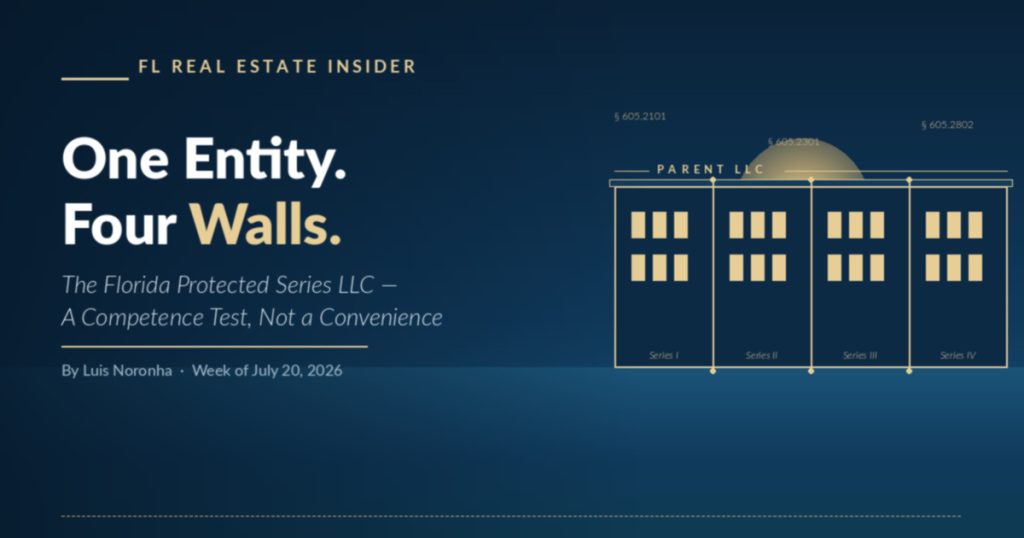
The Protected Series LLC is now law — in effect since July 1. It looks like a convenience. It’s really a competence test — and the smart money will pass it by default.
FL Real Estate Insider — Week of July 20, 2026 By Luis Noronha
Three weeks ago, on July 1, a quiet change in the Florida Statutes became one of the most consequential shifts in how Florida real estate is owned in years — and almost nobody outside a handful of law firms is talking about it.
Florida’s new Protected Series LLC law took effect that day. It lets a single parent LLC create multiple internal “series,” each with its own assets, its own members, and — this is the part that matters — a statutory liability wall between them. Hold ten properties in ten series, and a slip-and-fall judgment at one property is supposed to stay at that property, instead of reaching across and threatening the other nine. No ten separate companies. No ten sets of annual filings. One entity, walled off internally.
That’s the headline, and the legal blogs have covered the headline. What they’ve mostly skipped is the part a serious investor actually needs to hear: this structure is powerful, and it is unforgiving. It rewards discipline and quietly punishes everyone who treats it as a checkbox. Let me walk through what it is, and then I’ll tell you — marked plainly as my opinion — what I think it really signals.
What actually passed
The law is CS/SB 316, sponsored by Sen. Lori Berman, with a companion bill CS/HB 403 from Rep. Jenna Persons-Mulicka. Governor DeSantis signed it on June 20, 2025, with a delayed effective date of July 1, 2026 — the delay was requested by the Florida Department of State to give it time to build the new forms and filings into its systems. It adds new Sections 605.2101 through 605.2802 to the Florida Revised Limited Liability Company Act (Chapter 605), and it’s modeled on the Uniform Protected Series Act that the Uniform Law Commission promulgated in 2021. (Holland & Knight — Florida Passes New Protected Series LLC Legislation, Shumaker — Governor DeSantis Signs SB 316, Florida Senate — CS/SB 316 Bill Summary)
That last point matters more than it sounds. Florida didn’t invent something experimental here. Delaware has had series LLCs since 1996; Illinois, Nevada, Texas, and others followed. Florida studied all of them and built its version on the uniform framework — which means the law is comprehensive and the courts have a reasoned structure to work from, rather than the thin, untested statutes some states are stuck with. (Holland & Knight)
Here’s how it works in practice. An existing or newly formed Florida LLC acts as the “parent.” It creates a series by filing a “protected series designation” with the Department of State, with the unanimous consent of its members (unless the operating agreement allows less). Each series gets a name that has to begin with the parent’s name and include “protected series,” “P.S.,” or “PS.” From there, each series can have its own members, managers, purpose, and — critically — its own assets and liabilities, walled off from the parent and from every other series. (Holland & Knight, Munizzi Law — What Investors Need to Know Before July 1, 2026)
The drafters had real estate squarely in mind. The plain-language example used by the chair of the Florida Bar committee that wrote the law: “a real estate developer could have a series for residential housing, another for mixed-use and others for retail, commercial, office, golf courses, restaurants, healthcare, etc.” — one entity, an unlimited number of internally segregated buckets. (Holland & Knight)
The “horizontal shield” — and the catch that voids it
The genuinely new thing the law creates is what the statute calls a “horizontal” liability shield. Traditional LLCs give you a vertical shield — it protects the owners from the company’s debts, the way shareholders are protected from a corporation’s debts. The horizontal shield is different: it runs sideways, between series, so the creditors of one series can only reach that series’ assets — not the parent’s, and not any other series’. It has two parts: a non-liability rule (one series isn’t liable for another’s debts) and a non-recourse rule (a creditor can’t reach into another series’ assets). (Holland & Knight)
Now the catch — and this is the entire piece.
That shield only exists if you keep the records to support it. The statute requires strict, contemporaneous recordkeeping that segregates the “associated assets” and “associated liabilities” of each series. The legal standard, written into Section 605.2301(2)(a), is that your records must describe each asset with enough specificity that a “disinterested, reasonable individual” could identify the asset, distinguish it from every other series’ assets and the parent’s assets, determine when and from whom the series acquired it, and — if it came from the parent or another series — determine what was paid for it. (Holland & Knight)
Miss that standard, and the protection doesn’t just weaken — under the piercing-the-veil doctrine, a creditor can pierce both the horizontal shield and the vertical shield, exposing the other series and the parent. (Holland & Knight, Florida Bar Journal — Florida’s New Protected Series LLC Law, Part I) In plain English: sloppy books don’t just cost you the new protection. They can blow up the protection you already had.
A few more things worth knowing before anyone gets excited:
- Foreign LLCs can’t use it directly. An out-of-state LLC can’t create a Florida protected series — it has to form or domesticate a Florida parent first. (Holland & Knight, Berger Singerman — Florida’s Series LLC Law Takes Effect July 1, 2026)
- Other states may not honor the wall. Several states don’t recognize series LLCs at all, and there’s no guarantee their courts will respect the internal shields on a property or lawsuit in their jurisdiction. If your holdings cross state lines, the protection is only as good as the least-friendly court that touches it. (Holland & Knight)
- The financing and title plumbing is still catching up. The lending and title-insurance industries have not fully standardized how they underwrite, insure, or finance individual series. Anyone planning to mortgage a property held in a series should confirm lender and title acceptance before committing to the structure, not after. (Munizzi Law, Berger Singerman)
None of that makes the tool bad. It makes it a tool for people who do the work.
What I’d actually tell people
If you hold multiple Florida properties personally or in one big LLC: This is worth a real conversation with your attorney and CPA before year-end. The appeal — one entity, segregated risk, fewer filings than ten separate LLCs — is genuine. But the protection lives and dies on administration, so go in knowing you’re signing up for disciplined, separate bookkeeping per series, not a set-it-and-forget-it shortcut.
If you already run a clean, well-documented operation: You’re the ideal candidate. The structure rewards exactly the habits you already have.
If your books are a shoebox: Be honest with yourself. A protected series with sloppy records is arguably worse than what you have now, because the same sloppiness that voids the new horizontal shield can be used to pierce the vertical shield you were relying on. Fix the bookkeeping first, or don’t use it.
Everyone: This is general education, not legal advice — and the people who get series LLCs wrong almost always got them without counsel. Talk to a Florida attorney who does this work. (My own real estate legal work runs through Duane Morris; structure decisions like this are exactly the kind of thing I’d never do off a blog post, including this one.)
Bottom line
Florida just added a genuinely useful tool for owning real estate — and wrote it so that the tool only works for people disciplined enough to run it properly. The wall between your properties is real, but it’s made of recordkeeping, and it falls down the moment the recordkeeping does.
If you take one thing from this issue: the Protected Series LLC isn’t a convenience. It’s a competence test. And whether you pass it has nothing to do with the filing fee and everything to do with how you already run your business.
If this was useful, forward it to the partner or family member you co-own property with — the law is already live, and the structure decisions people make in the next few months will be the ones courts test later.
— Luis
From the Developer’s Seat
I want to mark what follows as my view from the developer’s seat, not legal reporting.
Every few years, Florida changes a rule in a way that looks neutral on paper but quietly tilts the field. The Building Code did it. The insurance reforms did it. The Live Local preemptions did it. And now the Protected Series LLC does it too — because a tool whose entire value depends on disciplined documentation, segregated capital, and competent counsel is, by definition, a tool that favors disciplined, well-advised, professionally-administered capital and disadvantages everyone winging it.
That’s the same divide I see on the building side of this business. The difference between a structure that holds in litigation and one that collapses is the same difference between a developer who underwrites every assumption and documents every dollar and an operator who doesn’t — and it’s the same standard a family office should demand of whoever holds its Florida exposure. The new law just put that standard into the statute.
That’s the lane Lana Development builds in — disciplined, code-current, developer-led ground-up new construction across Galleria Villages, Turquoise Homes, Waterview, and West Bay, held and operated to a standard that doesn’t flinch when the rules get more demanding. If you’re a HNWI or family-office investor who wants to see how that discipline shows up in the actual numbers of a live Florida pipeline, reply with “Investor Memo” and I’ll add you to a separate, accredited-only track I run alongside this newsletter.
FL Real Estate Insider exists to cover the parts of Florida real estate that get glossed over in the brokerage marketing emails. If this helped, hit reply — and if you want a referral to a qualified Florida attorney or CPA to talk through entity structure, I’m happy to point you to one. No pitch attached.
Sources
- Holland & Knight — Florida Passes New Protected Series LLC Legislation (June 24, 2025)
- Shumaker, Loop & Kendrick — Client Alert: Governor DeSantis Signs SB 316 (2025)
- Florida Senate — CS/SB 316 Limited Liability Companies, Bill Summary
- The Florida Bar Journal — Florida’s New Protected Series LLC Law, Part I
- Berger Singerman — Florida’s Series LLC Law Takes Effect July 1, 2026: Evaluate Your Business Structure Now
- Munizzi Law Firm — Florida’s New Protected Series LLC: What Business Owners and Investors Need to Know Before July 1, 2026
- Alper Law — Florida Series LLC: Protected Series Law (Effective July 2026)