← Lana Development | Projects | Contact

Tag: Family office

  • Florida Just Handed Real Estate Investors a New Way to Hold Property

    The Protected Series LLC is now law — in effect since July 1. It looks like a convenience. It’s really a competence test — and the smart money will pass it by default.

    FL Real Estate Insider — Week of July 20, 2026 By Luis Noronha


    Three weeks ago, on July 1, a quiet change in the Florida Statutes became one of the most consequential shifts in how Florida real estate is owned in years — and almost nobody outside a handful of law firms is talking about it.

    Florida’s new Protected Series LLC law took effect that day. It lets a single parent LLC create multiple internal “series,” each with its own assets, its own members, and — this is the part that matters — a statutory liability wall between them. Hold ten properties in ten series, and a slip-and-fall judgment at one property is supposed to stay at that property, instead of reaching across and threatening the other nine. No ten separate companies. No ten sets of annual filings. One entity, walled off internally.

    That’s the headline, and the legal blogs have covered the headline. What they’ve mostly skipped is the part a serious investor actually needs to hear: this structure is powerful, and it is unforgiving. It rewards discipline and quietly punishes everyone who treats it as a checkbox. Let me walk through what it is, and then I’ll tell you — marked plainly as my opinion — what I think it really signals.


    What actually passed

    The law is CS/SB 316, sponsored by Sen. Lori Berman, with a companion bill CS/HB 403 from Rep. Jenna Persons-Mulicka. Governor DeSantis signed it on June 20, 2025, with a delayed effective date of July 1, 2026 — the delay was requested by the Florida Department of State to give it time to build the new forms and filings into its systems. It adds new Sections 605.2101 through 605.2802 to the Florida Revised Limited Liability Company Act (Chapter 605), and it’s modeled on the Uniform Protected Series Act that the Uniform Law Commission promulgated in 2021. (Holland & Knight — Florida Passes New Protected Series LLC LegislationShumaker — Governor DeSantis Signs SB 316Florida Senate — CS/SB 316 Bill Summary)

    That last point matters more than it sounds. Florida didn’t invent something experimental here. Delaware has had series LLCs since 1996; Illinois, Nevada, Texas, and others followed. Florida studied all of them and built its version on the uniform framework — which means the law is comprehensive and the courts have a reasoned structure to work from, rather than the thin, untested statutes some states are stuck with. (Holland & Knight)

    Here’s how it works in practice. An existing or newly formed Florida LLC acts as the “parent.” It creates a series by filing a “protected series designation” with the Department of State, with the unanimous consent of its members (unless the operating agreement allows less). Each series gets a name that has to begin with the parent’s name and include “protected series,” “P.S.,” or “PS.” From there, each series can have its own members, managers, purpose, and — critically — its own assets and liabilities, walled off from the parent and from every other series. (Holland & KnightMunizzi Law — What Investors Need to Know Before July 1, 2026)

    The drafters had real estate squarely in mind. The plain-language example used by the chair of the Florida Bar committee that wrote the law: “a real estate developer could have a series for residential housing, another for mixed-use and others for retail, commercial, office, golf courses, restaurants, healthcare, etc.” — one entity, an unlimited number of internally segregated buckets. (Holland & Knight)


    The “horizontal shield” — and the catch that voids it

    The genuinely new thing the law creates is what the statute calls a “horizontal” liability shield. Traditional LLCs give you a vertical shield — it protects the owners from the company’s debts, the way shareholders are protected from a corporation’s debts. The horizontal shield is different: it runs sideways, between series, so the creditors of one series can only reach that series’ assets — not the parent’s, and not any other series’. It has two parts: a non-liability rule (one series isn’t liable for another’s debts) and a non-recourse rule (a creditor can’t reach into another series’ assets). (Holland & Knight)

    Now the catch — and this is the entire piece.

    That shield only exists if you keep the records to support it. The statute requires strict, contemporaneous recordkeeping that segregates the “associated assets” and “associated liabilities” of each series. The legal standard, written into Section 605.2301(2)(a), is that your records must describe each asset with enough specificity that a “disinterested, reasonable individual” could identify the asset, distinguish it from every other series’ assets and the parent’s assets, determine when and from whom the series acquired it, and — if it came from the parent or another series — determine what was paid for it. (Holland & Knight)

    Miss that standard, and the protection doesn’t just weaken — under the piercing-the-veil doctrine, a creditor can pierce both the horizontal shield and the vertical shield, exposing the other series and the parent. (Holland & KnightFlorida Bar Journal — Florida’s New Protected Series LLC Law, Part I) In plain English: sloppy books don’t just cost you the new protection. They can blow up the protection you already had.

    A few more things worth knowing before anyone gets excited:

    • Foreign LLCs can’t use it directly. An out-of-state LLC can’t create a Florida protected series — it has to form or domesticate a Florida parent first. (Holland & KnightBerger Singerman — Florida’s Series LLC Law Takes Effect July 1, 2026)
    • Other states may not honor the wall. Several states don’t recognize series LLCs at all, and there’s no guarantee their courts will respect the internal shields on a property or lawsuit in their jurisdiction. If your holdings cross state lines, the protection is only as good as the least-friendly court that touches it. (Holland & Knight)
    • The financing and title plumbing is still catching up. The lending and title-insurance industries have not fully standardized how they underwrite, insure, or finance individual series. Anyone planning to mortgage a property held in a series should confirm lender and title acceptance before committing to the structure, not after. (Munizzi LawBerger Singerman)

    None of that makes the tool bad. It makes it a tool for people who do the work.


    What I’d actually tell people

    If you hold multiple Florida properties personally or in one big LLC: This is worth a real conversation with your attorney and CPA before year-end. The appeal — one entity, segregated risk, fewer filings than ten separate LLCs — is genuine. But the protection lives and dies on administration, so go in knowing you’re signing up for disciplined, separate bookkeeping per series, not a set-it-and-forget-it shortcut.

    If you already run a clean, well-documented operation: You’re the ideal candidate. The structure rewards exactly the habits you already have.

    If your books are a shoebox: Be honest with yourself. A protected series with sloppy records is arguably worse than what you have now, because the same sloppiness that voids the new horizontal shield can be used to pierce the vertical shield you were relying on. Fix the bookkeeping first, or don’t use it.

    Everyone: This is general education, not legal advice — and the people who get series LLCs wrong almost always got them without counsel. Talk to a Florida attorney who does this work. (My own real estate legal work runs through Duane Morris; structure decisions like this are exactly the kind of thing I’d never do off a blog post, including this one.)


    Bottom line

    Florida just added a genuinely useful tool for owning real estate — and wrote it so that the tool only works for people disciplined enough to run it properly. The wall between your properties is real, but it’s made of recordkeeping, and it falls down the moment the recordkeeping does.

    If you take one thing from this issue: the Protected Series LLC isn’t a convenience. It’s a competence test. And whether you pass it has nothing to do with the filing fee and everything to do with how you already run your business.

    If this was useful, forward it to the partner or family member you co-own property with — the law is already live, and the structure decisions people make in the next few months will be the ones courts test later.

    — Luis


    From the Developer’s Seat

    I want to mark what follows as my view from the developer’s seat, not legal reporting.

    Every few years, Florida changes a rule in a way that looks neutral on paper but quietly tilts the field. The Building Code did it. The insurance reforms did it. The Live Local preemptions did it. And now the Protected Series LLC does it too — because a tool whose entire value depends on disciplined documentation, segregated capital, and competent counsel is, by definition, a tool that favors disciplined, well-advised, professionally-administered capital and disadvantages everyone winging it.

    That’s the same divide I see on the building side of this business. The difference between a structure that holds in litigation and one that collapses is the same difference between a developer who underwrites every assumption and documents every dollar and an operator who doesn’t — and it’s the same standard a family office should demand of whoever holds its Florida exposure. The new law just put that standard into the statute.

    That’s the lane Lana Development builds in — disciplined, code-current, developer-led ground-up new construction across Galleria Villages, Turquoise Homes, Waterview, and West Bay, held and operated to a standard that doesn’t flinch when the rules get more demanding. If you’re a HNWI or family-office investor who wants to see how that discipline shows up in the actual numbers of a live Florida pipeline, reply with “Investor Memo” and I’ll add you to a separate, accredited-only track I run alongside this newsletter.


    FL Real Estate Insider exists to cover the parts of Florida real estate that get glossed over in the brokerage marketing emails. If this helped, hit reply — and if you want a referral to a qualified Florida attorney or CPA to talk through entity structure, I’m happy to point you to one. No pitch attached.


    Sources

  • The Florida Luxury Buyer in 2026: Tighter, Wealthier, and More Durable Than the Headlines Suggest

    The “Florida is cooling” story is true for the median household and quietly false for the buyer who actually clears new luxury and move-up product. Here is what the data show — and what they mean for capital.

    FL Real Estate Insider — Week of June 8, 2026 By Luis Noronha


    There are two Florida housing markets right now, and almost every headline you have read this spring is describing only one of them.

    The first market is the one in the headlines: cooling migration, rising inventory, price cuts on the Gulf Coast, a median sale price that slipped 1.3% year over year to about $394,000 in the first quarter. That market is real, and if you own a 2004-vintage condo in an overbuilt corridor, it is the only market you can feel.

    The second market is the one I underwrite for a living — the buyer of well-built, code-current new luxury and move-up product. And in that market, the data is telling a very different story: fewer buyers than five years ago, but the ones who remain are wealthier, less leveraged, and more committed than at any point in recent memory.

    This week I want to lay out what the numbers actually say about the Florida luxury buyer in 2026, where the demand is concentrating, and — clearly marked as opinion at the end — what I think it means for capital deployed into ground-up Florida new construction.


    The migration story is more interesting than “it’s slowing”

    Start with the headline everyone leads with. Florida’s net domestic in-migration fell from 310,892 in 2022 to just 22,517 in 2025 — a roughly 93% collapse over three years, dropping Florida to eighth among the states for state-to-state migration. (Newsweek)

    That number is real. It is also incomplete in two ways that matter enormously if you are selling — or financing — luxury product.

    First, the migration is cooling, not reversing, and the people still arriving are dramatically wealthier than the people leaving. The most recent IRS migration data shows Florida captured a net $20.6 billion in adjusted gross income from interstate migration — nearly four times the gain of second-place Texas at $5.5 billion. The average AGI of a tax filer who moved to Florida from another state was $122,530, the highest of any state in the country, and the households arriving earned on average roughly 60% more than the households that left. (Florida Realtors) Palm Beach County alone posted a net income inflow of $22.7 billion from domestic migration over 2019–2023, ranking it first in the nation. (MIAMI REALTORS)

    Second, the international channel — the one that disproportionately feeds the Florida luxury market — is still running at the top of the country. In 2025 Florida led every state in net international migration, with 178,674 more people arriving from abroad than leaving. (Florida Realtors)

    So the honest read of the migration data is not “Florida is emptying out.” It is “the price-elastic middle-class family buyer is being squeezed out by affordability, while the high-income domestic mover and the international buyer — the two cohorts that actually clear luxury product — are still here.” The demand base is not shrinking so much as it is sorting.


    The luxury buyer is paying cash — which means rates barely touch them

    Here is the single most important fact about the Florida luxury buyer in 2026, and it is the one that explains why this cohort is insulated from the mortgage-rate environment that is punishing everyone else: at the top of the market, this is a cash market.

    At the top of the Miami-Dade condo market, 82% of $1 million-and-up sales closed all-cash in 2025 — against a national all-price share of about 25%. Four in five transactions in that tier never touch a lender. And the cash share runs deep below the luxury tier too: in June 2026, cash accounted for 38.1% of all Miami-Dade closed sales, 48.5% of existing condo sales, and 27.6% of single-family transactions. (MIAMI REALTORS®)

    When the buyer pays cash, a 7% mortgage rate is not a gate — it is a footnote. As one Palm Beach market read put it, in the high-end segment liquidity, not leverage, is setting the pace. (MILLION) That is exactly why the luxury tape and the broad tape have decoupled this cycle. The rate-sensitive buyer paused; the cash buyer did not.

    And the cash buyer kept buying. Closed sales of single-family homes priced above $1 million rose 15.2% year over year in April 2026 statewide. (letsmovetofla) In Miami, $1 million-plus single-family sales jumped 21.34% year over year, from 164 to 199 transactions. (Haute Residence) At the very top, sales above $10 million stayed historically active — 262 transactions in the first nine months of 2025, on pace for roughly 426 by year-end, close to the 2021 record. (MILLION)


    The supply picture is split down the same line as the demand picture

    This is where the two-markets framing becomes impossible to miss. Look at months of supply — the cleanest measure of who has pricing power.

    Statewide in June 2026, Florida single-family inventory stood at a 4.5-month supply while condo and townhouse inventory sat at 8.1 months — nearly double, in the same state, in the same month. (Florida Realtors) In Southeast Florida the gap is wider and more durable: the MIAMI REALTORS® outlook projects single-family months’ supply tightening from 5.7 at end-2025 to 4.9 at end-2026 and 4.2 at end-2027, while condo supply eases only from 12.9 to 11.6 to 9.6 — more than double the single-family figure at every point in the forecast, with the overhang concentrated in exactly the aging, pre-code, assessment-burdened stock I wrote about in The Condo Cliff. (MILLION)

    That is the whole story in two numbers. The well-built single-family and new-construction product the luxury buyer wants is getting scarcer. The older condo stock that buyer does not want is getting more abundant. Same state, same month, opposite markets.


    The wealth being created is structural, not a sugar high

    It would be easy to dismiss all of this as a post-pandemic hangover that fades. The wealth data says otherwise.

    Knight Frank’s 2026 Wealth Report — its twentieth edition — counts the global population of ultra-high-net-worth individuals (those worth more than $30 million) rising from 551,435 in 2021 to 713,626 in 2026: roughly 89 people crossing the $30 million threshold every single day. The United States created 41% of all the new UHNWIs in that period, lifting its share of global ultra-wealth from 33% to 35%. And 22% of UHNWIs plan to buy a luxury home this year. (Knight Frank, Think Global People)

    Florida sits directly in the path of that capital. Miami-Dade alone added 50% more millionaires over the past decade. (Family Wealth Report) The buyer pool for Florida luxury is not a pandemic artifact that reverts. It is being replenished, structurally, faster than the state can build product for it.


    From the Developer’s Seat

    What follows is my view, not statute or data — I want to mark that clearly.

    Here is what I take from all of this. The dominant 2026 narrative — affordability cliff, migration reversal, a cooling market — is accurate for the median Florida household and increasingly misleading for the buyer of code-current new luxury and move-up product. Those are two different markets, and the data has pulled them apart this cycle more cleanly than I have seen in fifteen years.

    The buyer who clears the kind of product I build is, today, more durable than at any point in the last five years: wealthier on arrival, paying cash, insulated from rates, drawn by lifestyle rather than a job relocation that can be reversed by a return-to-office memo, and being replaced from a global wealth pool that is growing by the day. Fewer total buyers — but the remaining ones are exactly the buyers a disciplined developer wants, and they are competing over a single-family and new-construction supply that is getting tighter, not looser.

    For an HNWI or family-office investor, the strategic point is this: the slowdown everyone is reading as a reason for caution is, in the luxury and move-up lane, a sorting mechanism that is concentrating demand into precisely the product code-current ground-up new construction produces. Backing a developer who builds for that durable end buyer is not a bet against the Florida cooling — it is a bet on which side of the cooling you are standing on.

    If you want to see how this buyer-durability framework applies to the live Lana pipeline — the specific corridors, the specific end-buyer profile, and the underwriting behind it — that is exactly the conversation the Lana Investor Memo is built for.

    → Request access at coastal-living-collection.com (accredited investors only).

    Until next week, Luis

    P.S. — Accredited investor? The Lana Investor Memo and the live pipeline behind this week’s thesis live here: coastal-living-collection.com.


    Sources


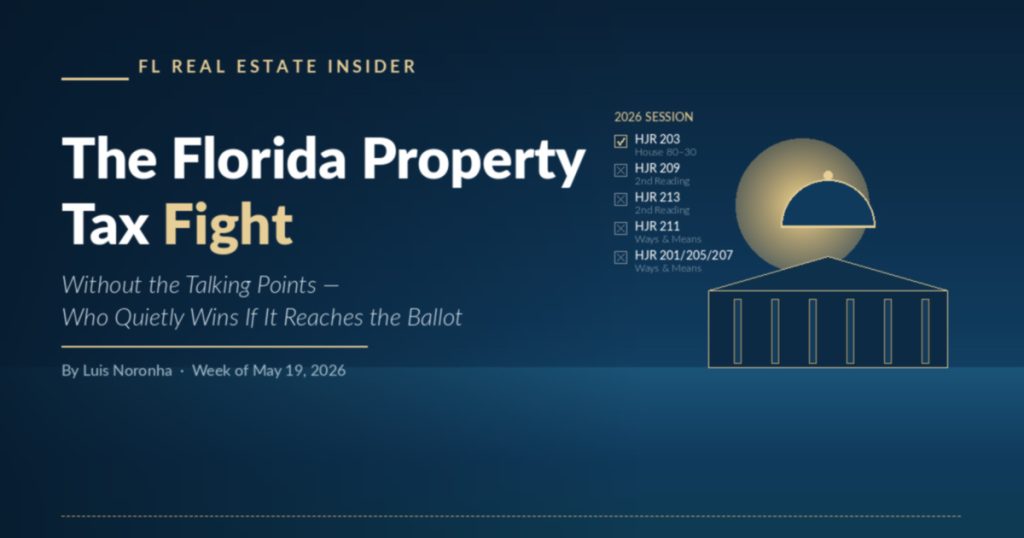
  • The Florida Property Tax Fight, Without the Talking Points

    What is actually on the table in 2026, what is not, and who would quietly win if any of it reaches the ballot

    FL Real Estate Insider — Week of May 18, 2026 By Luis Noronha


    For the last six months, every Florida real estate conversation I have been in eventually turns to the same question: “is the property tax thing actually happening?” The honest answer is that the political pressure is real, the proposals are real, and the mechanics of who would benefit are very real — but almost none of the public commentary you have read about it is accurate enough to use.

    So this week I want to do something different. I want to lay the actual proposals out side by side, with the bill numbers, what each one would do mechanically, where each one died in this past session, and what each would mean for a Florida property owner depending on whether you live in your house, rent it, or hold it as an investment.

    Then I will mark — clearly — what I think, separate from the statute.


    What is actually on the table

    Florida’s 2026 regular session produced a cluster of House Joint Resolutions aimed at homestead property taxes. They are not interchangeable. Each does something different, each cleared a different point in the process, and each carries a different bet about who benefits.

    HJR 203 — phased elimination of non-school property tax on homesteads. Increases the homestead exemption from non-school ad valorem taxes by $100,000 per year for ten years beginning in 2027, until homesteaded primary residences are fully exempt from non-school property tax by 2037. School property taxes are preserved. HJR 203 passed the House 80–30 on February 19, 2026 — the only proposal to receive a floor vote — and then died in the Senate Appropriations Committee when the regular session ended March 13, 2026 without a hearing. (HJR 203 bill page, Florida House, Florida Phoenix coverage, Florida Policy Institute bill summary)

    HJR 209 — a new $200,000 second homestead exemption conditioned on carrying comprehensive property insurance. Stacks on top of the existing homestead exemption, applies only to non-school ad valorem taxes, and applies only to homesteads carrying a comprehensive multiperil policy. The Revenue Estimating Conference put the local-government revenue cost at roughly $8.6 billion per year, and the legislative analysis estimated that about 83 percent of Florida homesteaded homeowners would qualify. HJR 209 cleared all of its committees but died on the Second Reading Calendar without a floor vote. (HJR 209 bill page, Florida House, Florida Policy Institute bill summary)

    HJR 213 — reassess homestead property every three years instead of every year, with the cumulative cap held at 3 percent or CPI. Materially slows assessed-value creep for long-tenured homesteaders. Cleared committees, died on the Second Reading Calendar. (Florida Policy Institute bill summary)

    HJR 211 — remove the $500,000 cap on Save Our Homes portability. Allows a homesteader to transfer the full accumulated SOH benefit to a new primary residence, not just the first $500,000. Stalled before Ways and Means. (Pegasus Lends portability summary, Florida Policy Institute bill summary)

    HJR 201, 205, 207 — additional homestead-exemption increases of varying sizes and structures. All stalled before Ways and Means. (Florida Policy Institute bill summary)

    Net of all of that: the 2026 regular session produced exactly one proposal that made it to a full chamber vote, and the April 2026 special session — which also covered the budget — adjourned without putting any property tax measure on the November 2026 ballot. (WFLX coverage of session end, Barnes Walker post-session update)


    What everyone is now waiting on

    The path forward, if there is one, runs through a third special session this summer. Governor DeSantis has signaled July or August 2026 as the likely window, contingent on a deal with the Senate. To get a constitutional amendment on the November 2026 ballot, both chambers need to approve it with a 60 percent supermajority, and the Secretary of State has a late-August certification deadline. Voters would then need to approve the amendment with a 60 percent supermajority to ratify it. (Fox Business — DeSantis phased approach, WFLX — third special session)

    The Senate is the real story. Senate President Ben Albritton has been explicit that the Senate is not ready to send a property tax amendment to the ballot without first solving for the impact on what he has called Florida’s “fiscally constrained” counties. Senate Appropriations Chair Ed Hooper put it more plainly: “There’s 67 totally different counties in this state, and a property tax issue that is great for one county could crush 31 poor counties.” (Florida Voice — Albritton final message, Florida Realtors — Lawmakers continue work on property tax plan)

    That is the negotiating wall. The House wants to give voters an option in November. The Senate wants to first answer the question “and how do small counties pay for sheriffs and roads?” before it agrees to anything.


    The replacement-revenue math, which is the part nobody on the political side wants to be specific about

    The piece of this that the talking points consistently soft-pedal is what replaces the revenue. Florida’s homestead non-school property tax base is large enough that the only credible single-lever replacement is a substantially higher sales tax. The Florida Policy Institute’s analysis concluded that fully replacing the lost revenue with sales tax would require Florida to roughly double its state sales tax to about 12 percent — which would be the highest state sales tax rate in the country. (Kiplinger summary of FPI analysis)

    Florida TaxWatch has not endorsed elimination either. Brandi Gunder, Florida TaxWatch’s vice president for research, said publicly that “tax levies are growing at an unsustainable pace” but also that any restructure “has to be a partnership between local, state — everybody on board to know how critical government services will be funded.” (WUSF — TaxWatch on property tax elimination)

    Translation: even the conservative-leaning fiscal watchdog is not going to wave this through without a credible replacement plan.


    What the live bills would actually do, for the actual people who own actual property

    This is where most of the public commentary breaks down. Let me put the mechanics in plain English.

    If you own and live in your home (homesteaded primary residence): every live proposal benefits you, on different timelines. HJR 209 would deliver the biggest immediate cut on day one — a $200,000 additional exemption stacked on the existing $50,722 baseline exemption (propertyexemption.com — Save Our Homes 2026 guide), conditional on carrying comprehensive insurance, for a total exemption around $250,722 on non-school taxes. HJR 203 would deliver a deeper cut but over a decade. HJR 213 would slow your assessed value growth. HJR 211 would let you carry your full SOH benefit to your next primary residence with no $500,000 cap.

    If you own a second home, an investment property, an Airbnb, or commercial property: none of the live proposals reduce your property tax. The phased elimination in HJR 203 specifically excludes non-homestead property; HJR 209 explicitly excludes non-homestead property; the SOH-related proposals are structurally tied to homestead status. The existing 10 percent non-homestead assessment cap (Florida Statute 193.1556) continues to apply, with the standard reset to full market value upon ownership change. (Pinellas County PA — Non-Homestead 10% Cap)

    If you rent in Florida: none of these proposals delivers you direct relief, and the replacement math is structurally regressive — sales tax falls more heavily on lower-income households as a share of income than property tax does. (Kiplinger summary of FPI analysis)

    If you are about to close on a new construction primary residence: this is the corner of the market that gets the least public attention and where the mechanics are most interesting. Under existing law, new construction is reassessed at full market value as of the first January 1 after substantial completion, and is added to the capped assessed value of the land. Once homestead is filed, the 3 percent (or CPI) Save Our Homes cap kicks in for the following year. (Florida Department of Revenue — Property Tax Information for First-Time Florida Homebuyers (PDF), § 193.155, Florida Statutes) Layering HJR 209 or HJR 203 on top of that mechanic would compress non-school property tax on a new code-current primary residence faster than on essentially any other asset class in the state.


    What I think — clearly marked as opinion

    I want to clearly mark what follows as my view, not statute.

    The political framing of this debate has been “homeowners versus government,” and that framing is making people miss the more important story. Every live proposal that came out of the 2026 session — HJR 203, HJR 209, HJR 213, HJR 211, all of them — concentrates the benefit on owner-occupied primary residences. By design. Some of them go further and condition the benefit on the property carrying insurance that an actual carrier is willing to write, which in Florida in 2026 means a structure built to current code is materially advantaged over older, harder-to-insure stock.

    If any version of this package reaches the November 2026 ballot and passes, three things follow.

    First, the relative carrying cost of a homesteaded primary residence drops, and drops most for higher-assessed-value homes — which is the segment with the largest absolute non-school millage bill. That is a transfer toward the move-up and luxury primary-residence buyer, which is the segment new code-current construction is built for.

    Second, the relative carrying cost of investor-held inventory — second homes, short-term rentals, institutional single-family-rental portfolios — does not drop. The owner-occupied buyer is being explicitly advantaged versus the investor buyer at the margin. That is a small but real tailwind for end-buyer-driven new construction and a small but real headwind for institutional SFR exposure in Florida — which builds on the pattern I have written about in prior issues. (FL Real Estate Insider — Wall Street Landlords)

    Third, the insurance-conditioned design of HJR 209 specifically rewards buildings that current Florida carriers are willing to write — which means, in practice, FBC-current construction. The reform package and the insurance market are quietly pointing at the same asset.

    I am not predicting any of these proposals passes. The Senate roadblock is real, the replacement-revenue problem is unsolved, and the political appetite for raising sales tax to 12 percent does not exist. The most likely outcome remains a partial package — most plausibly some form of HJR 209 (insured-homestead exemption) plus an expanded portability fix — rather than full HJR 203 elimination.

    But the part of this that will happen, whatever the November ballot ends up looking like, is that the political conversation is now permanently anchored on giving more of the tax relief to owner-occupied primary residences. That anchor is not moving. And whoever is positioned to sell or hold owner-occupied primary residences in Florida is on the right side of that anchor.


    From the Developer’s Seat

    This section is my view, not statute.

    I read the entire 2026 property tax package as a slow tilt of the rules toward exactly one buyer profile: the homesteaded, well-insured, primary-residence owner of a code-current Florida home. Every live proposal advantages that buyer. The 10 percent non-homestead cap (and the reassessment-on-sale mechanic) keeps the rules less favorable for investor-held and second-home inventory. The insurance condition in HJR 209 quietly favors structures that today’s carriers will write — which means structures built to current FBC. None of this is accidental.

    The practical implication for capital is straightforward. The Florida residential lane with the most political wind at its back is owner-occupied, code-current, primary-residence new construction priced for an HNWI move-up buyer. That is the lane Lana operates in. It is also the lane in which family-office and HNWI capital has a structural advantage over institutional capital, because the holding period, the buyer profile, and the underwriting risk are all things patient private capital handles better than a public REIT or a Wall Street SFR vehicle. If you are an accredited investor and want to see how this thesis is actually expressed in live projects with named underwriting, that is what the Lana Investor Memo is for. Reply to this email and I will add you to the next memo distribution.


    Sources

  • Why U.S. Real Estate Investment Remains a Smart Choice in 2026 — And Where the Structural Shift Is Real

    For accredited investors, family offices, and international allocators evaluating U.S. real estate investment in 2026, the fundamental question is not whether the asset class is attractive — the data settles that. The real question is where in the U.S. to be, what product to hold, and how to structure the exposure. This article walks through the macro case for U.S. real estate, and then focuses on where the structural shift is most acute and most durable: South Florida coastal.

    The macro case for U.S. real estate investment

    The United States remains the deepest, most transparent, and best-protected real estate market in the world. The Federal Housing Finance Agency’s House Price Index shows steady long-term appreciation across cycles. Property-title systems give both domestic and foreign buyers legally enforceable rights that most global markets simply cannot match. Foreign ownership faces almost no restrictions — a rarity globally.

    Population dynamics are equally supportive. According to the U.S. Census Bureau and IRS Statistics of Income migration data, between 2020 and 2025 net domestic migration to the Sunbelt exceeded 4 million people, with a disproportionately high-income skew. This is not a speculative wave. It is permanent household relocation driven by tax policy, cost-of-living arbitrage, and lifestyle preference.

    But “U.S. real estate is a good investment” is too broad to be actionable. Within the U.S., the outperformance is heavily concentrated. Let’s talk about where and why.

    Florida: the clearest structural shift in U.S. real estate investment

    Florida added more than 1.9 million residents between 2020 and 2025 — the equivalent of adding a city the size of Philadelphia. According to IRS SOI migration data, the average adjusted gross income of movers from New York exceeded $120,000; from Connecticut, $130,000. Florida has now absorbed more than $36 billion in annual adjusted gross income inflow.

    Three drivers make this durable:

    1. The tax advantage is constitutional. Florida requires a legislative supermajority to impose a state income tax. There is no serious political movement to change it. For a household earning $1M annually, the move from New York to Florida is worth roughly $90,000–$110,000 per year in preserved wealth.
    2. Supply cannot keep up. Coastal land is finite. Buildable footprint in Miami-Dade, Broward, and Palm Beach is constrained by ocean, wetlands, conservation areas, and post-Surfside code updates. Permitting runs 8–18 months in most premium submarkets.
    3. Construction costs are up 35–40% since 2020. According to the CoreLogic Construction Cost Index and BLS JOLTS data, labor shortages and material inflation have raised the barrier to new supply significantly — which structurally protects developers who can build at cost.

    Where investors get U.S. real estate investment wrong

    The most common mistake we see accredited investors make is treating “Florida real estate” as a monolith. Central Florida buy-and-flip strategies, Orlando short-term-rental plays, and Miami condo pre-construction each carry very different risk profiles. The strongest fundamentals concentrate in a specific set of coastal submarkets — Brickell and downtown Miami, Fort Lauderdale/Victoria Park corridor, Boca Raton and Deerfield Beach, and select 30A locations — where lifestyle demand, physical supply constraints, and buyer demographics converge.

    At Lana Development, our Coastal Living Collection portfolio strategy targets exactly this convergence: new-construction luxury residential in Florida’s most resilient coastal corridors, with cycles short enough to compound returns and exits structured at delivery rather than through long-term hold.

    The developer question that matters more than the market question

    Once you’ve decided where to be, the second question — who’s building your investment — matters just as much. According to research from the McKinsey Global Institute (“Reinventing Construction”), the average large construction project runs 16% over budget and 20% over schedule. That gap comes directly out of investor returns.

    A developer who outsources construction to a third-party general contractor absorbs a 15–20% GC markup, is exposed to change-order inflation, and has limited real-time visibility into the project. A developer who is itself a licensed general contractor eliminates the markup, controls the timeline, and can course-correct in weeks instead of quarters. On a $12M build, the difference can exceed $3M in preserved value — every dollar of which flows to the project’s return profile.

    This is the single most important structural question an accredited investor should ask about any real estate opportunity, and it is the reason Lana operates as both developer and licensed GC.

    Investment structures every accredited investor should understand

    Once you’ve settled on market and sponsor, the vehicle matters. Broadly, an accredited investor has four choices:

    • Public REITs — liquid, correlated with equity markets, high fees, dilute performance across hundreds of positions.
    • Private funds — blind pools, limited transparency, layered fees, long durations.
    • Traditional syndications — single-asset exposure, but often with promote structures that misalign GP and LP incentives.
    • Direct co-investment with a developer — single project, transparent economics, identical terms as the sponsor, distributions at exit.

    Each has a role. Our view is that direct co-investment with a developer who invests its own capital alongside LPs offers the cleanest alignment for accredited investors — because there is no scenario where the sponsor wins if the LPs don’t.

    Tax and legal considerations for U.S. real estate investment

    Direct ownership of U.S. real estate is broadly open to non-U.S. persons. Structures like LLCs, LPs, and (for certain investors) EB-5 pathways provide flexibility. The tax code allows depreciation to offset rental income, and 1031 exchanges permit deferral into like-kind assets. For foreign investors, tax treaties may minimize double taxation on repatriated proceeds — proper legal and tax counsel is essential and should be secured before any capital moves.

    The bottom line on U.S. real estate investment in 2026

    U.S. real estate remains one of the most durable investment categories in the world. But durability isn’t uniformly distributed. In 2026, the highest-conviction opportunity we see is in the coastal South Florida corridor — where structural demand and structural supply constraint have converged in a way that we don’t expect to reverse this decade. And the sponsor question — outsourced GC vs. in-house GC — matters more than most investors realize.

    If you’d like to talk through how any of this applies to your allocation strategy, schedule a 15-minute conversation with Luis Noronha.

    External sources