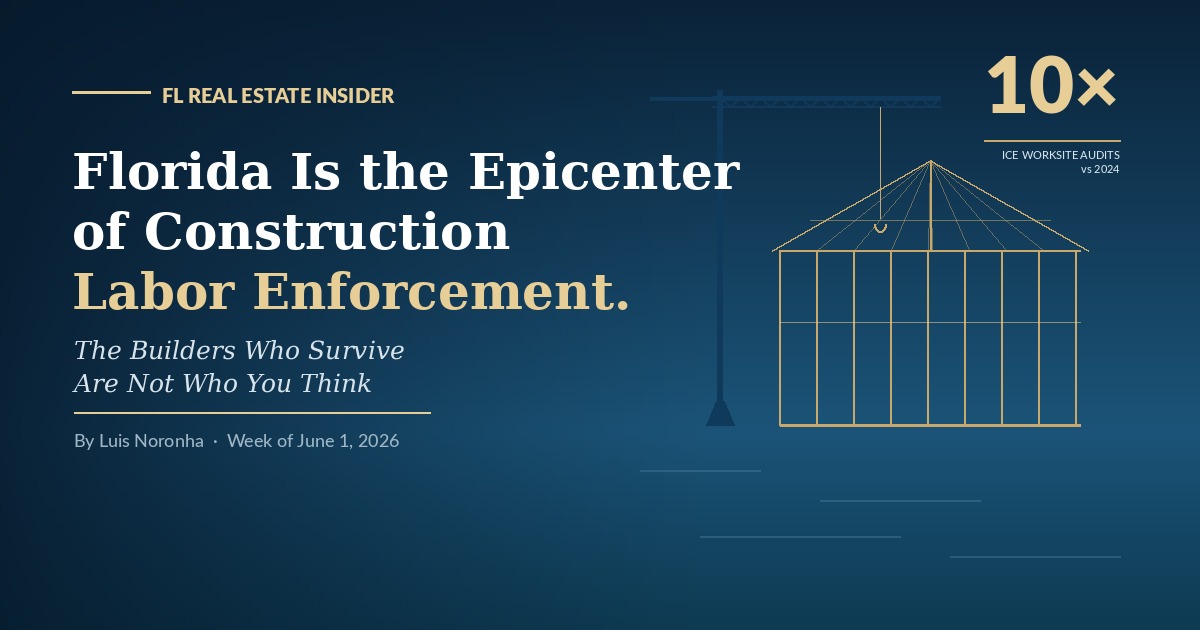
Three years of SB 1718, a 10-to-1 lead in 287(g) partnerships, and an ICE Notice-of-Inspection rate running ten times the 2024 pace are not punishing every Florida builder equally — they are quietly finishing what the rate cycle started.
FL Real Estate Insider — Week of June 1, 2026 By Luis Noronha
There is a number that should be the lead in every Florida real estate publication this June and is in almost none of them: as of June 11, 2025, Florida — three years into SB 1718 — had 295 active or pending 287(g) memorandums of agreement with ICE — more than three times the 95 in Texas and nearly nine times the 33 in Georgia. (Roofing Contractor — Florida Emerges as the Epicenter of ICE Raids)
That is not a marginal data point. That is the formal infrastructure of a worksite-enforcement regime that has, over the past fifteen months, made Florida the single most active state in the country for construction-site immigration action — by a margin of at least 10-to-1 compared to the next-closest state. (Roofing Contractor — Florida Emerges as the Epicenter of ICE Raids)
I want to lay out what the enforcement data actually shows, what the labor data actually says about Florida residential construction, who in the builder ecosystem absorbs the shock and who does not, and — clearly marked as opinion at the end — what I think it means for capital deployed into ground-up Florida new construction over the next 24 months.
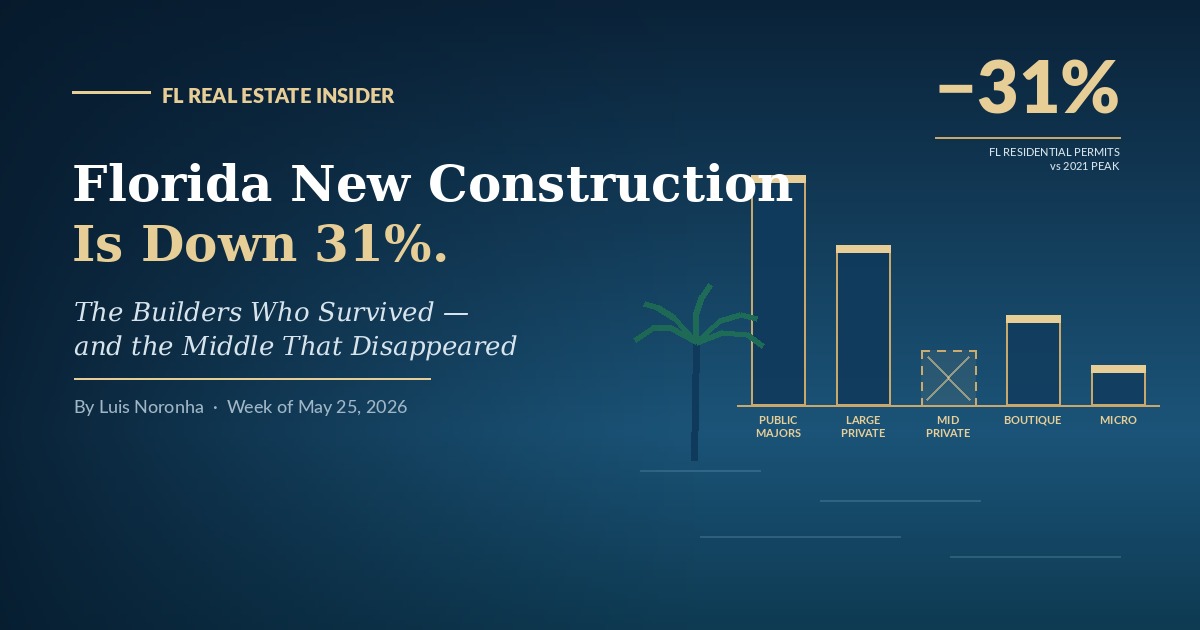
This piece is a direct continuation of the May 25 issue (Florida New Construction Is Down 31%. The Builders Who Survived Are Not Who You Think.). Last week I argued that the cost-of-capital wedge between the national publics and the mid-market private builder cohort is the single most under-appreciated story in Florida residential right now. The labor data published since then makes the same argument from the input-cost side. Read together, they tell a coherent story most coverage is still missing.
What the SB 1718 enforcement infrastructure actually looks like
The legal and operational machinery has three layers and all three matter.
Layer one — the statute. Governor DeSantis signed Senate Bill 1718 into law on May 10, 2023. The E-Verify requirement for private employers with 25 or more employees took effect July 1, 2023. The enforcement window — fines of $1,000 per day plus suspension of state-issued licenses for employers who fail to comply three times in any 24-month period — became operative July 1, 2024. (Greenberg Traurig — E-Verify: Florida Senate Passes Bill Requiring State Employers With 25 or More Employees to Use Platform Effective July 1, Bilzin Sumberg — Florida Law Imposes Additional E-Verify Requirements for Private Employers, Florida Senate — SB 1718 (2023) Enrolled Text)
Layer two — the federal operations. ICE’s rate of Notices of Inspection — the audit instrument that drives the bulk of worksite enforcement — ran in the first half of 2025 at least ten times the 2024 rate, with that pace expected to continue or accelerate through 2026 as funding expands and federal data-sharing agreements (including the recent IRS arrangement) come online. (American Immigration Council — Understanding ICE Raids at American Workplaces (October 2025 fact sheet))
Layer three — the named operations in Florida. The pattern is no longer theoretical. ICE Tampa’s Operation Tidal Wave in late May 2025 resulted in 1,120 arrests of removable individuals — the largest joint immigration operation in Florida history, per ICE. (ICE — ICE Tampa Conducts Worksite Enforcement at Rapidly Expanding Community, Arrests 33 Illegal Aliens) On May 29, 2025, ICE raided the FSU College Town construction site in Tallahassee and detained more than 100 workers in a single action. (Florida Phoenix — ICE Raids FSU College Town Construction Site, Buses Away Workers)
The three layers compound. The statute creates the compliance obligation, the federal audit cycle creates the documentation pressure, and the named operations create the day-to-day fear that disrupts crews independent of any individual worker’s status.
What the labor data actually says
The industry-level numbers are large and they are not improving.
The Associated Builders and Contractors estimates the U.S. construction industry must attract roughly 349,000 net new workers in 2026 just to meet demand, with that figure projected to rise to 456,000 in 2027 — a structural gap, not a cyclical one. (Construction Owners — Construction Workforce Crisis Deepens in 2026 Amid Labor Shortages and ICE Raids)
Recent industry-survey work shows 28% of construction firms experienced workforce disruption tied to ICE enforcement in the past six months, approximately 10% lost workers directly to enforcement actions or rumors of raids, and another 20% reported that their subcontractors had lost workers. (Construction Owners — Construction Workforce Crisis Deepens in 2026)
The structural exposure is concentrated where Florida residential construction actually happens. Immigrants comprise approximately 34% of all U.S. construction workers, with shares above 60% in drywall, roofing, and plastering trades, and in Florida specifically the share approaches or exceeds 40% across the residential build cycle. (Construction Owners — Construction Workforce Crisis Deepens in 2026, Construction Dive — ICE Raids on Building Sites Stoke Fear, Uncertainty)
Independent economic analysis estimates the Florida labor shortage alone could push the state’s GDP down by roughly $12.6 billion in a single year — about 1.1% of the state economy. (Bloomberg Línea — Which Sectors Are More Exposed to Florida’s New SB 1718 Laws?)
The honest read is straightforward. A statutory employment regime that disqualifies a meaningful slice of the residential trades labor pool, layered on top of a federal enforcement cycle running ten times the 2024 audit pace, layered on top of a Florida-specific 287(g) infrastructure that is the densest in the country, does not produce a marginal labor shortage. It produces a structural one. And that shortage shows up first and hardest in the trades that drive the Florida residential build cycle.
Who can absorb the shock
This is where the May 25 builder-consolidation analysis becomes important.
The national publics with self-perform crews, in-house framing and concrete divisions, captive subcontractor relationships, and balance-sheet capacity to over-hire ahead of crew shortages have a structural cushion the private mid-market builder does not. Lennar reported Q1 2026 net earnings of $0.93 per diluted share — a 57% decline from $2.14 in Q1 2025 — but new orders nonetheless grew 1% year-over-year to 18,515 homes. (Lennar — Lennar Reports First Quarter 2026 Results (March 12, 2026)) PulteGroup reported Q1 2026 home sale revenues of $3.3 billion — down 12% year-over-year — with closings down 7% to 6,102 homes and average selling price down 5% to $542,000. (TradingView — PulteGroup Stock Down on Earnings Q1 Miss, Revenues Beat on Orders) D.R. Horton’s guidance for fiscal 2026 closings is 86,000 to 87,500 homes — close to flat against fiscal 2025’s 84,863 closings. (D.R. Horton — Q1 FY2026 Earnings Release)
The pattern is the same on the cost side as it was on the demand side: margin compression at the publics, with volume intact. The publics are taking the labor and incentive hit through reduced earnings per share, not through reduced production. They can do that because their scale lets them.
The mid-market private builder running the same project against the same labor environment cannot.
The 2025 Florida builder-failure list I cited in last week’s issue makes the contrast plain — Pegasus Builders (Chapter 11 mid-2025, ~$10M debts), Van Der Valk Construction (Chapter 11 April 30, 2025, 58 homeowners affected), Sion Homes (Chapter 7 September 2025, liabilities over $1M against less than $1,000 cash), Phil Kean Designs Inc. (Chapter 11 Subchapter V late November 2025). (Medium — Luxury Home Builders Collapse Across Florida Amid Market Shifts, TheStreet — Luxury Homebuilder Files for Chapter 11 Bankruptcy) Every one of these is a builder with a long track record — and every one of them was operating in the price tier where labor cost is a meaningful share of finished value and the captive-crew advantage of the publics is decisive.
The mechanism is straightforward. When a Lennar or D.R. Horton project loses framing crew capacity to an enforcement event, the parent company can redirect from another active project, draw on a captive sub network with national reach, or run a forced-buyout incentive package on the next start window to retain crews. The mid-market private builder running off three or four open-market trade partners on a single project does not have any of those levers. The crew that walked off on Tuesday morning does not come back on Wednesday at the same cost basis.
That is the labor side of the cost-of-capital wedge. The May 25 piece described the financial side — rate-buydown subsidies the publics can offer that the private cannot, land-banking pipelines the publics access through institutional partners the private cannot, mortgage-subsidiary captive financing the private has no analog to. The labor side now sits alongside those three: a fourth structural advantage that flows mechanically to scale, and a fourth structural disadvantage that flows mechanically to anyone without it.
What this is doing to the surviving lane
Now I want to clearly mark what follows as my view, not statute.
The labor crunch, like the financial wedges I wrote about last week, is reshaping the competitive set of Florida residential builders far more aggressively than it is reshaping the demand for code-current new construction. The two effects are not the same and they should be priced separately.
On the demand side, the labor disruption matters surprisingly little for the HNWI move-up buyer. A buyer absorbing a $1.5M to $4M asset is not price-elastic on a $10,000 to $40,000 finished-cost delta tied to labor pass-through. The end-buyer pool for code-current new construction in the corridors where this matters — Galleria Villages, Turquoise Homes, Waterview, West Bay — is dominated by buyers who pay cash or carry low leverage and who care more about delivery quality and timing than about the marginal cost line. The labor crunch may stretch delivery, but it does not break absorption in this tier.
On the supply side, the labor disruption matters enormously, but the wedge it creates favors the surviving cohort. The national publics absorb the cost through margin compression and keep producing volume in the merchant-build price tier. The disciplined private developer operating in the HNWI move-up tier passes a portion of the cost through to a buyer who is largely insensitive to it, and protects the rest through trade-partner relationships built over years of consistent delivery. The mid-market private builder running merchant-build economics with open-market crews is the cohort being eliminated.
That is — in my view — exactly the right competitive set for Florida residential to settle into. Volume merchant-build product needs the scale advantages of the publics to be delivered profitably. The HNWI move-up tier needs the discipline and trade-partner depth of an established private developer that does not need to compete on volume. The mid-market merchant-build segment — the lane that has been hollowing out — was always the structurally weakest because it lacked both the scale of the publics and the price-tier insulation of the disciplined private.
From the Developer’s Seat
The labor regime in Florida is not going to ease over the 24-month horizon any disciplined capital allocator should be underwriting against. The statute is in place, the enforcement infrastructure is the densest in the country, and the federal audit pace is structurally higher than it was 18 months ago. Capital deployed into Florida residential between now and the back half of 2027 has to be priced against that reality.
My view — clearly marked as opinion — is that the labor crunch is one more reason the right structure for Florida residential capital today is patient HNWI and family-office co-investment alongside a disciplined developer operating in the HNWI move-up tier. The leveraged merchant-build lane is exposed to a wedge it cannot close. The volume merchant-build lane is reserved for the publics that have the scale to absorb it. The HNWI lane has the price-tier insulation, the trade-partner relationships, and the patience that the moment actually rewards.
If you are an accredited investor evaluating Florida residential allocation against this backdrop, I would rather show you the underwriting than argue with you about it. The Lana Investor Memo lays out our active pipeline, the specific projects, the named underwriting, and the structure we use to invest alongside HNWI and family-office capital. It is private, accredited-only, and shared with serious allocators. Reply to this email if you would like to opt in.
Sources
- Roofing Contractor — Florida Emerges as the Epicenter of ICE Raids
- Construction Dive — ICE Raids on Building Sites Stoke Fear, Uncertainty
- Construction Owners — Construction Workforce Crisis Deepens in 2026 Amid Labor Shortages and ICE Raids
- American Immigration Council — Understanding ICE Raids at American Workplaces (October 2025 fact sheet)
- ICE — ICE Tampa Conducts Worksite Enforcement at Rapidly Expanding Community
- Florida Phoenix — ICE Raids FSU College Town Construction Site, Buses Away Workers
- Florida Senate — SB 1718 (2023) Enrolled Text
- Greenberg Traurig — E-Verify: Florida Senate Passes Bill Requiring State Employers With 25 or More Employees to Use Platform Effective July 1
- Bilzin Sumberg — Florida Law Imposes Additional E-Verify Requirements for Private Employers
- Paychex — Understanding Florida’s E-Verify Mandate
- Bloomberg Línea — Which Sectors Are More Exposed to Florida’s New SB 1718 Laws?
- Lennar — Lennar Reports First Quarter 2026 Results (March 12, 2026)
- TradingView — PulteGroup Stock Down on Earnings Q1 Miss, Revenues Beat on Orders
- D.R. Horton — Q1 FY2026 Earnings Release
- Medium — Luxury Home Builders Collapse Across Florida Amid Market Shifts
- TheStreet — Luxury Homebuilder Files for Chapter 11 Bankruptcy