Statewide closings fell in August for the first time in a year, and Florida Realtors’ own economist blames rates. Above $1 million, they grew. And the Lennar region that includes Florida took the company’s steepest drop in new orders.
FL Real Estate Insider — Week of September 21, 2026
By Luis Noronha
12–0. That was the vote on Wednesday, September 16, when the Federal Open Market Committee raised the federal funds rate by a quarter point, to a range of 3.75% to 4.00%. (Federal Reserve — FOMC statement, September 16, 2026)
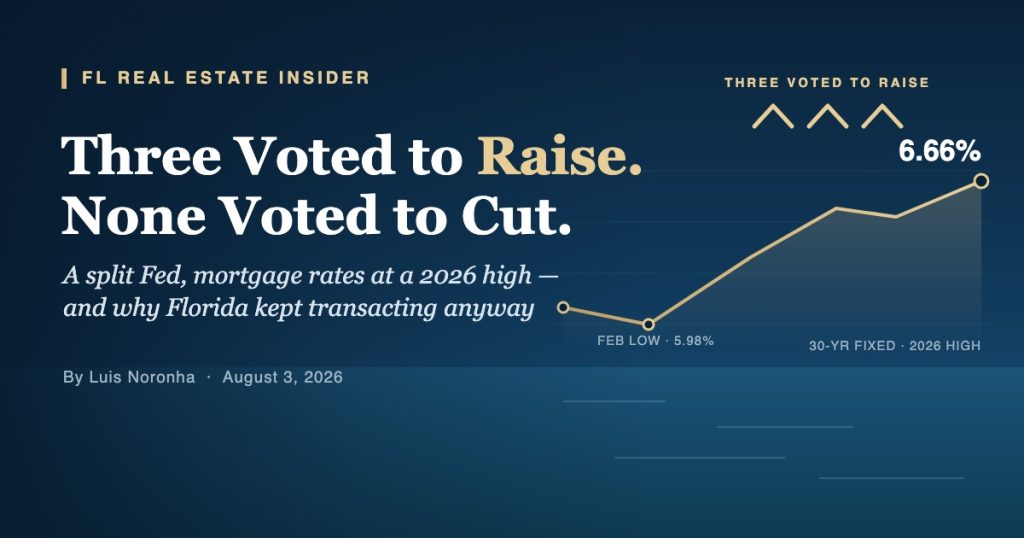
In July, three members wanted this hike and lost. In September, nobody dissented. (FOMC statement, July 29, 2026)
In August I wrote that the July statement was “not a committee looking for a reason to cut”. Seven weeks after that July meeting, it raised.
The same day, Florida Realtors published its August numbers and Lennar reported its quarter, with the earnings call the next morning. Read together — my assessment, not theirs — the three releases test what this newsletter has argued since August. Not all of it held.
The Fed’s own projections took a 2026 cut off the table
The decision was a quarter point. The projections are the bigger news.
The Fed’s Summary of Economic Projections asks each of the 18 participants where the policy rate should sit at year-end. The median answer for 2026 was 3.4% in March, 3.8% in June, and 4.1% on September 16. For 2027 it jumped from 3.6% to 4.1%. (Federal Reserve — SEP, September 16, 2026; June 17; March 18)
The arithmetic worth doing yourself: the new range has a midpoint of 3.875%. One more quarter point, to 4.00%–4.25%, has a midpoint of 4.125%. A 4.1% median is one more hike across the two meetings left this year, October 27–28 and December 8–9. And the lowest of the 2026 projections is 3.9% — the rate where it now sits.
Not one participant projects a lower rate by December.
Chairman Kevin Warsh, at the press conference:
“I would be hard-pressed to describe broad financial conditions as restrictive. This view was widely shared by the Committee. So we removed a dose of accommodation.” (Federal Reserve — press conference transcript, preliminary, September 16, 2026)
The same projections put PCE inflation at 3.7% for 2026 and do not reach 2.0% until 2029.
The mortgage market got there first
Freddie Mac’s 30-year fixed averaged 6.95% in the week ending September 17 — up from 6.76% the week before and 6.26% a year ago. (Freddie Mac PMMS) In Freddie’s own history file, that is the highest weekly reading since January 2025.
A scope note, because it changes what the number means: the survey covers Thursday through Wednesday, and six of those seven days closed before the 2:00 p.m. announcement. My read is that the 6.95% mostly reflects the market pricing the hike in advance, not reacting to it.
Florida’s August: the statewide number went the wrong way
I’d rather put this first than have you find it.
Closed sales of existing single-family homes in Florida totaled 21,497 in August, down 1.4% from a year earlier. That ended a run of 11 consecutive months of year-over-year gains. The median held up — $415,000, up 1.2% — on 4.3 months of supply. (Florida Realtors, September 16, 2026)
Dr. Brad O’Connor, Florida Realtors’ chief economist, was direct about the cause:
“…on the margin, the recent rise in rates has been enough to slow home sales growth, and the affordability constraints induced by elevated mortgage rates are likely going to be with us for the foreseeable future.”
And the detail that hurts my own recent argument most: statewide single-family cash sales fell 2.1% — faster than sales overall — to 5,782, and the cash share slipped from 27.1% to 26.9%. (Florida Realtors — August 2026 single-family data detail (PDF))
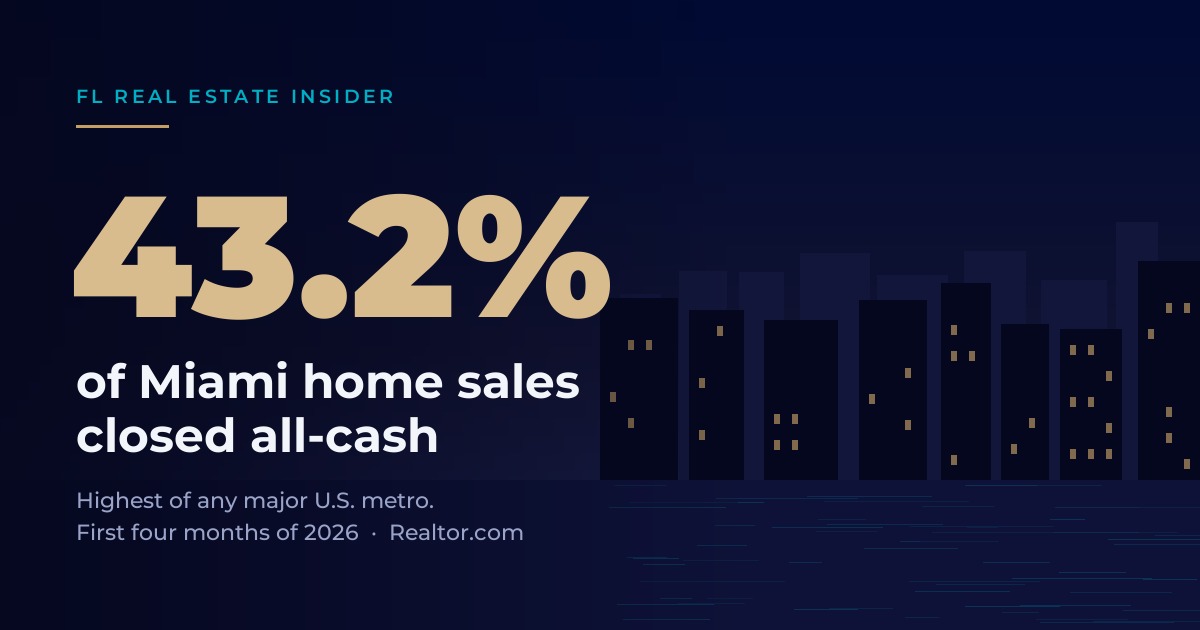
Two weeks ago I wrote about Florida’s 41.3% all-cash share and argued that for the cash-heavy end buyer, the Fed is a second-tier variable. That was Realtor.com’s deed data for the first four months of the year; this is Florida Realtors’ MLS data for one month, and the two are not one series. But if the argument were that Florida’s cash buyers carry the whole state through rising rates, August doesn’t support it.
Here’s the split the statewide headline hides
The statewide release doesn’t show it. Page 8 of the same PDF does.
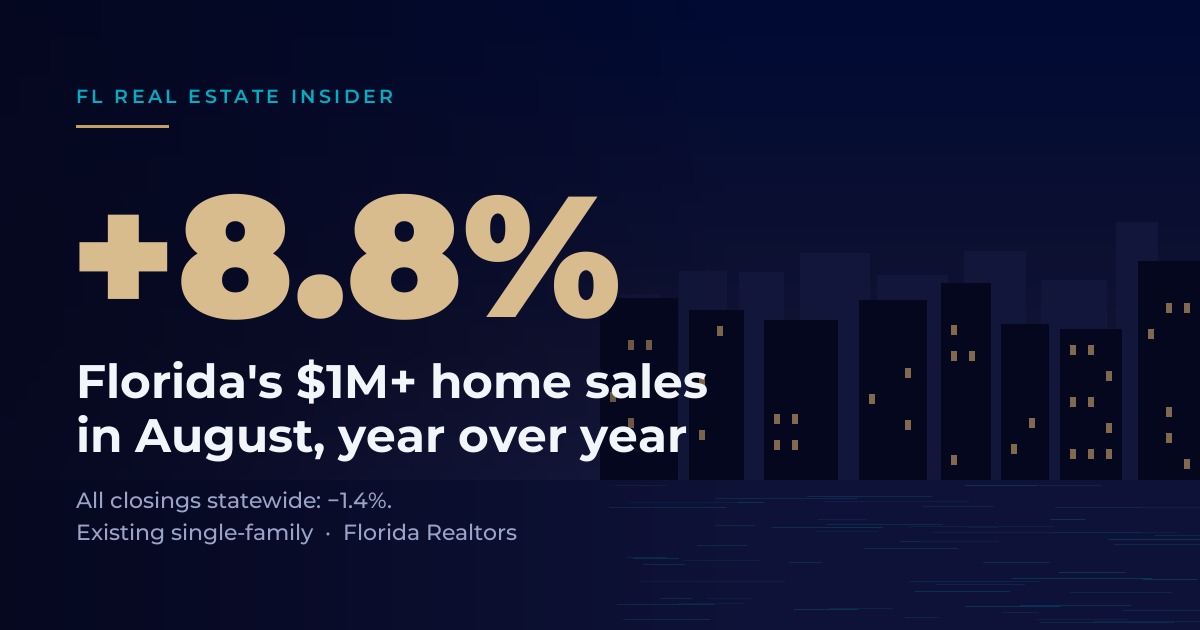
- $1 million and up: 2,087 closings, up 8.8%.
- $1.5 million to $2 million: up 25.3%. $2 million to $3 million: up 22.9%.
- $300,000 to $399,999 — the state’s largest single band: 5,443 closings, down 6.1%.
Everything under $1 million, taken together, fell about 2.4%. That is my arithmetic, not Florida Realtors’: 21,497 total minus 2,087 at $1 million-plus leaves 19,410, against roughly 19,880 a year earlier (21,798 total, less about 1,918 at $1 million-plus, backed out of the 8.8% growth rate).
Three limits, and each one matters. This is one month. It is existing homes only — it says nothing directly about new construction. And Florida Realtors does not publish a cash share by price tier, so I cannot tell you how many of those 2,087 buyers skipped the lender. I won’t imply it.
So the Florida market did not weaken evenly in August. My interpretation of why: it weakened where buyers finance and grew where they have the most balance sheet — the pattern the June issue on the Florida luxury buyer described, now visible in a statewide table. Whether that top-tier strength was cash-funded, this data can’t tell me — which is why I’m not scoring the September 9 argument on it.
What one of the nation’s leading homebuilders said about the middle
Lennar’s quarter ended August 31. Earnings were $1.19 a share, against $2.29 a year earlier. The average delivered home sold for $372,000, “reflecting approximately 12.0% in incentives, along with base price adjustments.” Gross margin on home sales fell to 15.8% from 17.5%. New orders fell 9%, and the company cut its full-year delivery target to 80,000–81,000 homes from 82,000–83,000. (Lennar — Q3 2026 results, September 16, 2026)
Lennar reports Florida inside an “East” segment that also includes New Jersey and Pennsylvania, so Florida can’t be isolated. But East new orders were 4,831 against 5,792 a year earlier — down 16.6%, the steepest decline of Lennar’s four regions.
In my reading, Stuart Miller made my August argument more bluntly than I did:
“The Federal Reserve’s assistance is clearly off the table for practical purposes and not a near-term source of relief… Rate cuts when they eventually come, will be a meaningful tailwind for our business, but we are not holding our breath… we are not building our business plan around those rate cuts.” (Lennar Q3 2026 earnings call, via The Motley Fool transcript, September 17, 2026)
He named the competitor, too: resale sellers, with listings “particularly high” in Texas and Florida, “especially at our price range.” On cost, labor “has started to become more of an issue,” citing immigration enforcement — a pressure I wrote about in June’s issue on Florida construction labor enforcement — and competition from data-center construction.
Lennar’s $372,000 national average falls in Florida’s largest price band, where closings fell 6.1%. My read, marked as opinion: the pressure from rising rates is concentrated where a builder paying about 12% in incentives and a resale seller cutting price are fighting over the same qualified, financed buyer — a fight the top of the market isn’t in.
From the Developer’s Seat
From here on I’m arguing, not reporting — the conclusions are mine, drawn from the evidence above.
The Fed’s own projections show no cut this year, and Lennar’s CEO says the company isn’t building its plan around one; my conclusion, unchanged since August, is that nobody should underwrite a Florida project on the promise of rate relief. Where I’d sharpen my September argument: August’s strength came from the top of the price range, not from cash carrying the state — and in my experience the buyer there is often weighing an older resale house against a code-current new build, the choice I build for. That’s where patient, low-leverage capital has its edge: it doesn’t need the Fed to carry the project, and it builds for a buyer with the balance sheet to close whatever the Fed does. So, a question for anyone allocating here: roughly what share of your Florida exposure depends on a buyer who needs a 7% mortgage to close?
If you want to see how I stress-test rate and end-buyer assumptions in live underwriting, that’s what the Lana Investor Memo is for.
→ Request access at coastal-living-collection.com (accredited investors only).
Until next week,
Luis
Sources
- Federal Reserve — FOMC statement, September 16, 2026
- Federal Reserve — FOMC statement, July 29, 2026
- Federal Reserve — Summary of Economic Projections, September 16, 2026 (PDF)
- Federal Reserve — Summary of Economic Projections, June 17, 2026 (PDF)
- Federal Reserve — Summary of Economic Projections, March 18, 2026 (PDF)
- Federal Reserve — Transcript of Chairman Warsh’s Press Conference, September 16, 2026 (preliminary, PDF)
- Federal Reserve — FOMC meeting calendar
- Freddie Mac — Primary Mortgage Market Survey, September 17, 2026 and historical weekly data
- Florida Realtors — Fla.’s Housing Market: Median Prices Hold Steady as Pace Eases (September 16, 2026)
- Florida Realtors — Monthly Market Detail, August 2026, Single-Family Homes (PDF)
- Lennar — Lennar Reports Third Quarter 2026 Results (September 16, 2026)
- The Motley Fool — Lennar (LEN) Q3 2026 Earnings Call Transcript (September 17, 2026)
- Prior published: The Fed Held Rates Last Week — and Three Officials Voted to Raise Them (August 3, 2026) · Cash Buyers Are Pulling Back Nationally. In Miami They’re Still 43.2% of the Market. (September 9, 2026) · The Florida Luxury Buyer in 2026 (June 8, 2026) · Florida Has Become the Epicenter of Construction Labor Enforcement (June 1, 2026)