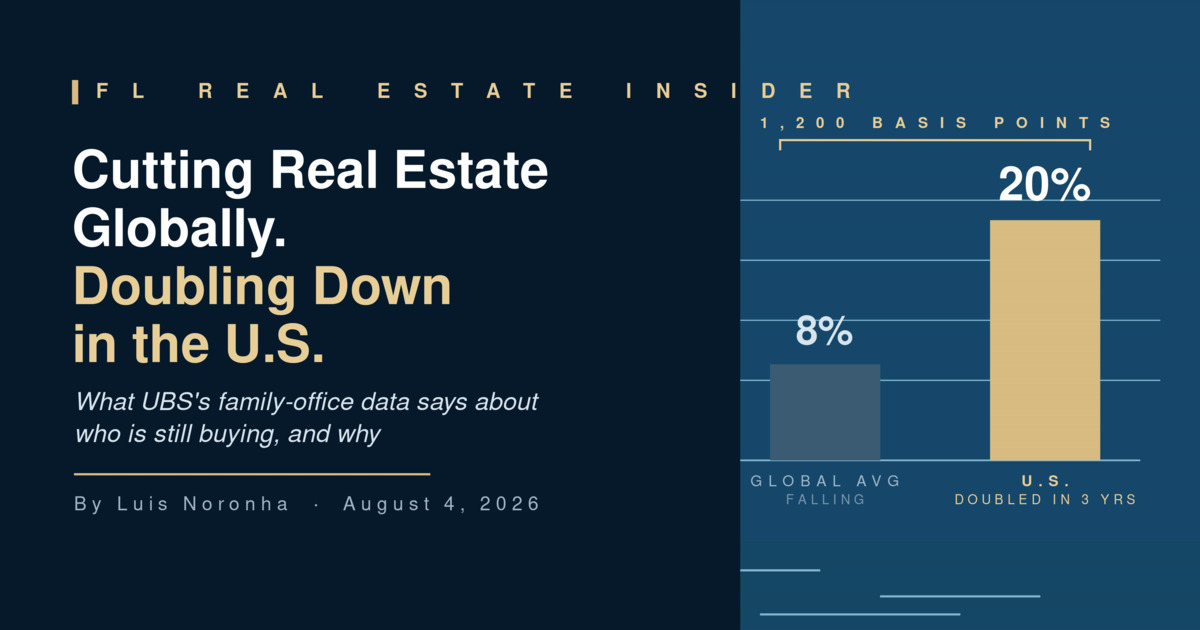
UBS’s 2026 survey of 307 family offices shows the global real estate allocation falling from 11% to 8% this year. In the United States, it has doubled to 20% over three years — and UBS’s own head of portfolio strategy says the reason is undersupply and tax benefits. That is not a contradiction. It is a sorting mechanism, and it favors exactly the product this newsletter is written about.
FL Real Estate Insider — August 4, 2026
By Luis Noronha
UBS’s 2026 Global Family Office Report has a global headline that sounds like bad news for real estate: family offices are planning to cut real estate to 8% of portfolios this year, continuing a slide from 14% in 2019 to 11% in 2025. (UBS — Global Family Office Report 2026, Modus — Allocation Alterations, Dollar Fears and Fewer Direct Investments)
One paragraph further, the story flips. In the United States, the average family-office real estate allocation has doubled over the past three years to 20% — and UBS expects it to stay there. (Modus)
That is not a rounding error. That is a twelve-hundred-basis-point gap — 20% versus 8% — between what the average global family office is doing with real estate and what the average U.S. family office is doing with it, inside the same survey, in the same report. This week I want to walk through what UBS actually found, what the deal-level data says about who is still buying, and — marked clearly as my view — what the divergence means for the kind of capital and the kind of product this newsletter covers.
What UBS actually surveyed
The Global Family Office Report is UBS’s own research, not a third-party poll. This year’s edition drew on 307 family offices across more than 30 markets, with an average family net worth of $2.7 billion and an average $1.3 billion in assets under management per office, surveyed online between January 22 and March 30, 2026. Only 12% of respondents were based in the U.S.; the largest blocs were Europe excluding Switzerland (30%) and Asia Pacific (23%). (UBS)
The headline finding is that a record share of family offices — 60%, the highest in the survey’s history, against roughly a third or less in most years this decade — plan to change their strategic asset allocation in the next 12 months. Geopolitical conflict topped the list of concerns cited, at 64% over the next year and 61% over five years, ahead of a debt crisis, a financial-market crisis, and a global recession. (UBS)
That 60% figure is a global average, though: only 21% of U.S.-based family offices in the survey plan to change their allocation this year, a fraction of the global share. (Modus) The rest of the world is repositioning. U.S. family offices, on the whole, are holding.
The real estate number, and the one nobody is quoting next to it
Inside that broader allocation story, real estate is one of the assets losing share globally. Max Kunkel, UBS’s chief investment officer for global family and institutional wealth, put it plainly: “real estate is one of the areas where clients are scaling back,” explaining that “the lower allocation is partly explained by recent relative performance and the near-term outlook, which has favoured other asset classes” — while adding that “the allocation to real estate remains sizeable.” (IFC Review, republishing Spear’s — Family Offices: Sharp Rise in Family Office Plans to Shift Strategic Allocations)
That is the quote most coverage stopped at. Daniel Scansaroli, UBS’s head of portfolio strategy and multi-asset solutions for the Americas, gave the number the global framing skips: U.S. family-office real estate allocation has doubled over three years to 20%, and he named two specific reasons. First, supply: “There is just not enough supply, especially in multifamily housing.” Second, tax treatment: “That, coupled with depreciation and the tax benefits in the U.S., has made the asset class even more attractive.” (Modus)
Those two reasons together are a fairly precise description of the argument this newsletter has been making since June: undersupplied, well-built product, held for its depreciation profile, is exactly what a disciplined U.S. real estate allocation should concentrate in right now — which is the same case I laid out for ground-up new construction generally and, more specifically, for the cash-heavy, rate-insensitive buyer at the top of the Florida market. UBS is not describing Florida specifically here — this is a national U.S. figure — but the mechanism it names is the one Florida’s own supply data has been showing for months.
The deal-level data confirms it is not paper allocation
A portfolio-allocation survey can be soft — intentions, not transactions. FINTRX, which tracks family-office deal activity directly, published a first-half count that lines up with the UBS finding.
FINTRX tracked 55 direct real estate transactions by family offices in the first half of 2026, across eight property types and six countries, involving 39 unique family offices. (FINTRX — Family Office Real Estate Investment Activity: 1H 2026) Two details in that count matter more than the topline.
First, this was overwhelmingly a single-family-office activity: 31 of the 39 participating offices were single-family offices, versus 8 multi-family offices, and 50 of the 55 deals — 91% — closed inside the United States. (FINTRX) FINTRX’s own read is that “direct real estate ownership in 1H 2026 was overwhelmingly a single-family activity,” with single-family offices structurally advantaged by fewer stakeholders to align and faster decision cycles — often with a founder who built the family’s wealth in real estate or an adjacent industry to begin with. (FINTRX)
Second, multi-family residential led every other property type, at 14 of the 55 deals, ahead of retail (13) and office (11). (FINTRX) That is the same asset class Scansaroli named as the specific supply gap driving the U.S. allocation higher — not a coincidence so much as the same shortage showing up twice, once in a survey answer and once in closed transactions.
A handful of single-family offices are doing this repeatedly rather than opportunistically. Real Capital Solutions, the office behind Chairman Marcel Arsenault — who has personally acquired and managed more than 365 real estate investments totaling roughly $3.5 billion over his career — closed seven transactions in the period, all office properties. BruttenGlobal closed four, spanning retail and multi-family. (FINTRX) FINTRX’s advice to sponsors raising capital is itself the tell: prioritize direct outreach to family principals over broad institutional channels, because the offices transacting repeatedly are running real estate as a deliberate, programmatic strategy, not a one-off allocation. (FINTRX)
Why this is a Florida story even though the UBS number is not
To be direct: UBS’s 20% and FINTRX’s 55 deals are national counts, not Florida ones. But the family-office capital doing the concentrating has been arriving in Florida in a way that is not in dispute. Ken Griffin’s move of Citadel and Citadel Securities from Chicago to Miami is the clearest single marker: the firm bought the 1201 Brickell Bay Drive site for a record $363 million in 2022, tapped Related Companies to co-develop a Foster + Partners-designed headquarters tower, and site work is now underway ahead of vertical construction, with Griffin having completed his Chicago real-estate exit in late 2025. (The Real Deal — Ken Griffin Taps Related Cos. to Co-Develop Citadel’s $1B-Plus Miami HQ) Altss, which tracks family-office formation through Florida Division of Corporations filings and property records, describes Miami as the fastest-growing family-office metro in the Western Hemisphere over the past three years, with New York, California, Chicago, and Latin American principals relocating or opening secondary offices. (Altss — Family Offices in Miami)
That inflow is the same buyer pool I described in the Florida Luxury Buyer issue two months ago: wealthier on arrival, less leveraged, and increasingly likely to hold and deploy capital through a family office rather than write a single personal check. My inference, not UBS’s finding: if that capital’s institutional home base is structurally overweight U.S. real estate for the reasons Scansaroli named, the Florida allocation from this cohort is more likely to keep compounding than to fade with the broader migration-cooling headlines.
From the Developer’s Seat
What follows is my opinion, not the UBS survey and not FINTRX’s transaction data — I want to mark that clearly.
The headline read on this report is “family offices are pulling back from real estate,” and for the global average, that is a fair summary. But a shrinking global pool of family-office real estate capital, combined with a U.S. allocation moving in the opposite direction for supply and tax reasons, is not bad news for the lane Lana operates in. It is a filter.
Less capital chasing real estate broadly means the sponsors who can prove they belong in the 20%-and-holding U.S. cohort — not the 8%-and-falling global one — capture a larger share of what is committed, not a smaller one. FINTRX’s own data backs that up: the family offices actually closing deals are disproportionately the disciplined, repeat, single-family-office buyers, not diversified institutional allocators spreading a check across a fund. That is precisely the buyer this newsletter and the standard I’ve argued a family office should hold any sponsor to are built around: an investor doing real, direct diligence on a specific developer and a specific pipeline, not renting broad real estate beta.
The two reasons Scansaroli gave for the U.S. overweight — insufficient supply and favorable depreciation treatment on newly placed assets — both point toward the same conclusion I have made in this newsletter before: they favor ground-up, code-current new construction specifically, not real estate as an undifferentiated category. A family office moving capital into that 20% U.S. allocation gets the most out of both of Scansaroli’s reasons when the asset is new.
So here’s the question I’d put to any family office reading this: is your 20% real estate allocation sitting in assets that actually capture the supply gap and the depreciation benefit Scansaroli is describing, or in a diversified basket that happens to be labeled “real estate”? Those are not the same allocation, even at the same percentage.
If you are deciding how to deploy into that 20%, I would rather show you the underwriting behind a live Florida pipeline than argue the macro case further. That is exactly the conversation the Lana Investor Memo is built for.
→ Request access at coastal-living-collection.com (accredited investors only).
Until next week, Luis
P.S. — Accredited investor? The Lana Investor Memo and the live pipeline behind this week’s thesis live here: coastal-living-collection.com.
Sources
- UBS — Global Family Office Report 2026: Family offices pivot to resilience as geopolitical risk and structural uncertainty reshape global portfolios (May 28, 2026)
- Modus — Allocation Alterations, Dollar Fears and Fewer Direct Investments: The Aberrant Findings in UBS’s 2026 Global Family Office Report (May 29, 2026)
- IFC Review, republishing Spear’s — FAMILY OFFICES: Sharp rise in family office plans to shift strategic allocations (May 29, 2026)
- FINTRX — Family Office Real Estate Investment Activity: 1H 2026 (July 20, 2026)
- The Real Deal — Ken Griffin Taps Related Cos. to Co-Develop Citadel’s $1B-Plus Miami HQ (January 24, 2025)
- Altss — Family Offices in Miami: Migration Hub of the Americas
- FL Real Estate Insider — Florida New Construction Is Down 31%
- FL Real Estate Insider — The Florida Luxury Buyer in 2026
- FL Real Estate Insider — What to Look For in a Sponsor You Want to Invest With