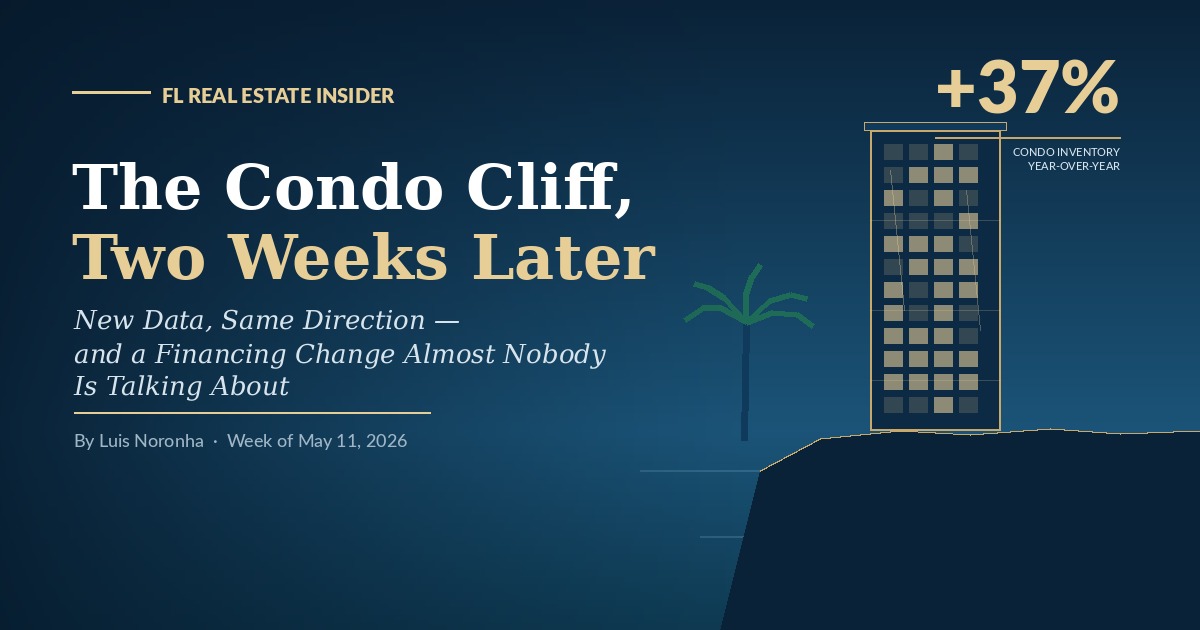
New data, same direction — and a financing change in August that almost nobody is talking about
FL Real Estate Insider — Week of May 11, 2026 By Luis Noronha
Two weeks ago I wrote that Florida’s older-condo market is at the front of this story, not the back of it — that the reform is right, the transition is being managed thinly, and the market has not yet priced what’s coming. Several readers wrote back asking the same thing in different words: fine, but show me the numbers.
Fair. So let’s look at what’s actually moved in the last few weeks. Nothing in the data changes the thesis. If anything, it sharpens it.
The inventory picture
The clearest signal is supply, and the cleanest way to see it is condo inventory measured against single-family in the same state in the same month. Statewide, Florida condo and townhouse inventory stands at an 8.1-month supply against 4.5 months for single-family — nearly double. (Florida Realtors) In Southeast Florida the gap is wider and the forecast says it persists: the MIAMI REALTORS® outlook has condo months’ supply at 12.9 at the end of 2025, easing only to 11.6 by the end of 2026 and 9.6 by the end of 2027, while single-family tightens from 5.7 to 4.9 to 4.2. (MILLION) Those are levels that in any normal market would be flashing red — and they are forecast to stay elevated through 2027.
Inside that headline, the inventory is not evenly distributed. Newer-build condos are still trading on relatively normal timelines. The supply pileup is concentrated in older coastal buildings — exactly the cohort caught in the post-SB-4D capital cycle, and exactly the cohort I described two weeks ago. (NBC 6 South Florida — surge in condo listings)
This is what “we are at the front of this story” looks like in data. Supply is building. Pricing in the older segment hasn’t yet fully adjusted to it, because most sellers are still anchored to 2022–2023 comps. That gap — between supply reality and seller expectation — is where the opportunity sits.
What the assessments actually look like (without making numbers up)
I refused to quote an “average” assessment last issue, because there isn’t one. There still isn’t. But there is now enough public reporting to talk about ranges responsibly.
Reporting across covered buildings, particularly 1975–1995 mid- and high-rise towers, shows special assessments commonly in the $30,000 to $75,000 per unit range, with combined roof, concrete restoration, and waterproofing programs producing assessments above $100,000 per unit in the most exposed buildings. Some industry coverage cites a broader observed range of $5,000 to $150,000 per unit, which is consistent with the variance you’d expect across age, reserve discipline, and structural condition. (Florida Realty Marketplace — 2025 Condo Bill, MishTalk — Florida Condo Owners Dump Units)
The scale of the population affected matters more than any single number: roughly 900,000 Florida condo units sit in buildings 30+ years old and are inside the regulatory perimeter. That is the cohort the market is going to have to digest over the next 24 months. (Aerially — SB-4D Complete Guide)
The financing change in August that almost nobody is pricing in
Here is the development that has moved most since the last issue, and that almost none of the residential agents I’ve spoken to are talking about yet.
Effective August 3, 2026, Fannie Mae is eliminating Limited Review for condominium loans. Every condo loan in a project with more than ten units will require a Full Review. The lender-delegated Full Review covers reserves (15% minimum), insurance adequacy, deferred maintenance, special assessments, and litigation — the exact items SB-4D is forcing out into the open in older Florida buildings. (CommunityPay — Fannie Mae Eliminates Limited Review, BCP Mortgage — Fannie Mae 2026 Condo Guidelines)
Translation, in plain English: starting in August, the conforming financing path for an older Florida condo runs straight through the same documentation that SB-4D is generating. A building with an incomplete milestone inspection, an unfunded SIRS, or an active uncalled assessment is going to look different to an underwriter on August 3 than it did on August 2.
For context on where the universe currently sits: as of last summer, only about 3.6% of condo projects nationally were flagged “ineligible” in Fannie Mae’s Condo Project Manager system. The top two reasons: insufficient master insurance and critical repair issues, including failure to meet state or local inspection requirements. With the policy change, the practical bar for a condo loan goes up across the board — and disproportionately in Florida. (Fannie Mae — Ineligible Projects, KSN Law — Fannie Mae Unavailable List)
There is one favorable counter-development worth naming. As of March 18, 2026, Fannie Mae retired the Florida-specific PERS pre-review step for new or newly-converted attached condo projects, putting Florida new construction back on the same lender-delegated Full Review footing as the rest of the country. That helps new-build supply. It does nothing for the 30-year-old tower with a pending assessment. (Fannie Mae Condo Project Manager FAQs (March 2026))
The bifurcation between buildings that can be conventionally financed and buildings that effectively cannot is about to get sharper. And it will start showing up in price before the year is out.
The opportunity I flagged last time, with the timing window now visible
This is the part where I owe readers more than I gave them in the last issue.
The case I made was that for the prepared cash buyer or experienced operator, the post-SIRS environment creates real opportunity in older buildings — provided you underwrite the building, not the unit. That is still true. What’s clearer now is the window.
The SIRS completion deadline is December 31, 2026 — about seven months from today. (Florida Engineering LLC — Building Safety Act 2025 Guide) Between now and then, three things are happening simultaneously:
1. More SIRS reports are being issued, meaning more buildings move from “unknown” to “documented” — and documented is generally better for a serious buyer than unknown. 2. Inventory is continuing to build in older coastal stock, putting downward pressure on prices in buildings that have not yet completed their cycle. 3. The August Fannie Mae change is going to thin the financed-buyer pool in many of these same buildings, leaving cash buyers and portfolio lenders with less competition.
Read those three together. The next two to three quarters are the period where a disciplined buyer, willing to do the underwriting work, has the most leverage. After the SIRS deadline passes and the dust settles, the better-managed older buildings will reprice upward as the uncertainty discount comes out. The badly-managed ones will keep drifting.
The market still has not priced this. It is starting to.
What I’d tell different people today
These are the same audiences I addressed two weeks ago. The advice is the same; the urgency is higher.
If you own in a covered building: Get the SIRS, the milestone inspection, and the current reserve balance, and look at them honestly. If your building is still vague on timing, the August Fannie Mae change is a strong reason to push your board for clarity now. A building that closes 2026 code documented compliance and a credible capital plan is going to trade meaningfully differently than a building that doesn’t.
If you serve on a board: Communicate. The owners who feel ambushed are the ones who flood the market with simultaneous listings and crater building values for everyone. The boards getting the best outcomes right now are the ones running the most transparent processes — not the ones trying to spin them.
If you’re a buyer with cash or portfolio financing: This is the underwriting window. Look for buildings that have done the work, priced the work, and started executing — and where seller expectations haven’t yet caught up to the SIRS disclosure. Get the documents before you make an offer, not after. Underwrite the building. Then underwrite the unit.
If you’re a legislator: A bridge financing or deferred-payment mechanism for long-tenured owners hit by six-figure assessments would still be the right move. We are not running out of time to do this. We are running out of political room to do it cleanly. The Aug 3 Fannie Mae change is going to make the affordability cliff more visible in real time. Please act.
Bottom line
Nothing in the data of the last two weeks contradicts what I wrote two weeks ago. The market still hasn’t priced this. The opportunity is still real for the prepared. The window is starting to narrow.
If you read the last issue and forwarded it to one person, this is the one to forward to a second.
— Luis
From the Developer’s Seat
Several readers wrote back after the last issue with a version of the same question: if the older-condo segment is this dislocated, why aren’t you — a Florida developer — building in it?
I want to mark what follows as my view from the developer’s seat, not market reporting.
The economics of ground-up, code-current new construction, in product types where the end buyer is HNWI rather than rate-sensitive, run in the opposite direction of what’s hitting older condos. New product is built to current Florida Building Code and prices accordingly on insurance. It doesn’t trip the Fannie Mae review screens described above, because the deferred maintenance, the unfunded SIRS, and the milestone-inspection backlog simply don’t exist on day one. And in my experience underwriting buyers for new luxury and move-up Florida product, the end buyer is materially less interest-rate-sensitive than the cohort being forced out of impaired older towers.
The dislocation in the resale-condo segment isn’t a headwind for the new-construction-for-HNWI lane. It’s a tailwind. Capital displaced from impaired older stock has to land somewhere, and well-positioned new product is one of the few places left where it can.
That is the lane Lana Development builds in — Galleria Villages, Turquoise Homes, Waterview, West Bay. If you’re a HNWI or family-office investor evaluating where Florida residential capital actually has an edge in 2026, reply with “Investor Memo” and I’ll add you to a separate, accredited-only track I’m setting up alongside this newsletter.
FL Real Estate Insider exists to cover the parts of Florida real estate that get glossed over in the brokerage marketing emails. If this helped, hit reply with the building you’re worried about — I’m happy to point you to a qualified attorney, structural engineer, or broker. No pitch attached.
Sources
- Florida Realtors — Florida home sales gain momentum, extend growth streak to 10 months (July 17, 2026)
- MILLION — South Florida Luxury Real Estate Outlook 2026-2027 (MIAMI REALTORS® Southeast Florida Housing Outlook data)
- NBC 6 South Florida — Experts expect surge of South Florida condo listings
- Florida Realty Marketplace — New Florida Condo Bill in 2025
- MishTalk — Florida Condo Owners Dump Units Over Six-Figure Special Assessments
- Aerially — Florida SB-4D Complete Guide to Milestone Inspections
- CommunityPay — Fannie Mae Eliminates Limited Review for Condos (Aug 2026)
- BCP Mortgage — Fannie Mae Condo Guidelines 2026
- Fannie Mae — Ineligible Projects (Selling Guide B4-2.1-03)
- KSN Law — Is Your Condo or HOA on the Fannie Mae Unavailable List?
- Fannie Mae — Condo Project Manager FAQs, March 2026
- Florida Engineering LLC — Florida Building Safety Act 2025: Complete Guide